Thursday, 13 January 2022

Tenemos mucho que celebrar

We have much to celebrate

Easter 2019 was the last time we had seen the Valencia apartment. The last time we had enjoyed one of our tastes of Valencian life. Then a long-term rental landed, then a pandemic landed. Then more tenants… until there was eventually a chance to visit as 2021 drew to a close.

After much debate around Covid, testing, travel restrictions, the state of Manchester Airport, Spanish Covid measures, etc, we decided late in the day that we were going to take our December 31st flights and get back there. We felt how important it was to celebrate how lucky we are to have this home. A place in this great city.

A visit lasting from December 31st-January 10th takes in 2 great celebrations: Nochvieja (New Year’s Eve, “out with the old, in with the new” and all of that) and the big celebration of Los Tres Reyes Magos on January 6th.

If there are celebrations to be had, then Valencia is the place to have them. In doing some very brief research, I uncovered various versions of the generally accepted reputations (N.B. not necessarily my views or experiences) of the inhabitants of the 17 Spanish regions. Some of the more well known might be:

Andalucia: funny, a bit lazy, talk a lot.
Cataluña: Want independence* and don’t want to spend any money, ever.
Aragón: Brutish, shout a lot, stubborn.
Asturias: Nationalists, drink a lot.

Every region has it’s own reputation, and to avoid perpetuating regional stereotypes any further, I won’t list any more. 

As for Valencians, I have seen them described as the nice version of Catalans, but this seems a little churlish. More famously, Valencians are known to be funny, proud people who just love to party. Shit, do they know how to celebrate. You only have to hear stories from the huge March Fallas festival to know that a sleepless week of drinking and seemingly lethal pyrotechnics is well within their remit.

The climax of Nochevieja would normally be a large crowd in Plaza Ayuntamiento cheering incredible fireworks and chomping down on 12 grapes (one for each chime) and plenty of cava, to see in the New Year. Sadly, the Ministerio de Sanidad had no choice but to order the closure of Plaza Ayuntamiento to prevent large crowds.

Nonetheless, our dinner that evening was a delight. In the height of the Covid crisis, I had made a modest financial contribution to help a favourite restaurant have much-needed income when closed due to the restrictions. As well as genuinely wanting to help, I’ll admit to a selfish motivation in wanting to see this special place open on our next visit. Mercifully, so it was. The owner showed his gratitude, making our evening special. The amazing Italian/Spanish food hadn’t faltered, and his welcome and warmth made it a celebration. The restaurant had been able reopen, and he and his staff still had jobs. His excellent wine was not the only thing that gave a warm feeling inside.

(We returned a week later. The welcome was the same, the food still amazing. The limoncillo was repeatedly pressed into our welcoming hands with increased enthusiasm).

Without the Plaza Ayuntamiento to go to, we made it home in time to see the Nochevieja fireworks from the balcony. The roof may have been better, but it was occupied by our neighbour and his extended family. We had already had some contact with this likeable vecino and his little dog on earlier visits, and as he has just become El Presidente of the Communidad de Propietarios, we let him have the roof.

The "barrio"
In typical style, spectacular fireworks continued for over an hour, and some long into the night. An apartment opposite partied until after 6am. You should celebrate when you’re young and you have a guitar. 

This appears to be an appropriate time to take stock of the things we
have to celebrate so far, for there are already many to be grateful for:

• Welcome and respectful tenants
• Being lucky enough to travel at short notice, despite everything
• Our home in Valencia
• Valencia itself
• The hope and optimism of a New Year
• Valencians
• Warm and friendly hosts and their excellent food and wine
• Affable and influential neighbours
• Fireworks done properly

We set about re-acquainting ourselves with the apartment. We explored it once again, and looked closely to see how it had changed, how it had been used. We set about re-acquainting ourselves with Valencia also. Felt like it was OK to get a bit touristy. Shopped a bit. 

We loved the now pedestrianised Plaza Ayuntamiento. We’ve always loved this huge square with the Town Hall and the incredible Edificio de Correos building, but without traffic, it’s so much better. The winter light treated the architecture with a more delicate reverence than the summer glare. We also loved the reassuring permanence of El Corte Inglés around the corner**.

Having had quite a high occupancy during the many months since our last visit, the apartment certainly showed it had been lived in, but not in a bad away. 

We found things left behind that linked us to our tenants and their stories: A travel card for Bucharest used as a bookmark. Mail for a Spanish doctor. Left-behind notes made in web publishing seminars, with Portugese names and references. I like the diverse nature and nationalities of our tenants. Now that we have had news of a new tenant for mid-January until mid-February, this our list of Nations, in chronological order:

Spain
UK
Malta
Ireland (we think)
Romania
Brazil (but with acquired Spanish citizenship?)
The Netherlands

For me, this is something to celebrate. I love that diversity. I love that in our tiny part of a country like Spain, a modest place can welcome diverse nationalities and backgrounds, different occupations and lifestyles, different people in different situations, with different needs, wants and ambitions.

"Before our race, nationality, or religion, we are all human beings. Let's celebrate our differences and not fight over them."

Rosie Fellner 

The rastro has moved. Fortunately I had checked this before we set off. The Sunday morning rastro (fascinating flea market/antique sale/place to buy knock-off stuff) is now held on a wide corner plot close to the Cemeterio de Cabañal, having been previously held in the Mestalla football stadium car park. An hour or two (with a mindful hand on your phone and wallet) picking your way around the rastro is a Sunday morning well spent. All the while you resolve to come back and find a use for that huge mirror and those hefty antique ceramics, which will not be there when you return, of course. In any case, you have no practical means of transporting them back to your apartment, it’s just the simple pleasure of browsing.

Then a meander through the Cabañal towards the Marina de Valencia for beers in the sun and paella, como siempre. The Cabañal used to be a characterful, attractive area in a gritty, doggedly authentic kind of a way. This is the old fishing quarter of Valencia where we would only really visit for the Easter parades and a particular favourite restaurant.

But how it’s transforming, now that it’s free from an old threat of ruin prescribed by a previous Town Hall regime. With no loss of character, buildings are restored and cleaned and painted with taste and style. Weaving through the small, quiet streets to Calle Reina, you get a sense of regeneration and a real drive to improve. Coffee and pastries on Calle Reina for half the price of the city centre, and on to the Marina de Valencia, past the visiting circus (gasps of delight from the audience inside) and onto the F1 track towards the Veles Y Vents*** building and the comfortable restaurants & bars beyond.

The Veles y Vents building basks in the sunshine.
Valencia's weather was a world away from the 2nd January we normally shiver through over 2000km to the North. Veles Y Vents shimmered its sparkling whiteness in warm sunshine, now a building very much in use with restaurants and bars in and around it. After sunshine drinks, a long lunch and the sleepy trip home.


And there’s another thing. The long lunch. In the UK, this may now only be the preserve of the privileged few, and we should claim it back. We mused over the latter part of another long lunch later in the visit that this is something that many people could do well to make a habit of. The type/amount/quality of the food and/or drink does not matter. What matters is taking your time. You don’t need to finish lunch to go and write that email right now. You don’t need to go and buy that “vital” thing right now. You don’t need to wash these things up right now. You don’t need to be in a particular place in the next 45 seconds. Take your time. Enjoy the open-endedness of it.

The Spanish have a lovely word: sobremesa. As in: “Los domingos la sobremesa hasta bien entrada la tarde”. “On Sundays table talk was prolonged until late in the afternoon”.

You’ll see sobremesa around the tables in La Pepica on a Sunday afternoon. Large, extended families of 4 generations enjoying each others company and talking (all at the same time) over tables laden with glasses, desert plates and coffee cups. The waiters won’t disturb it or press them to pay the bill… they know it’s important. Let’s do that more often.

Yes, they'll bring gifts if you've
been good. But no parade.

But the build-up to Los Tres Reyes Magos was gathering pace. Traditionally in Valencia (and in much of Europe) the festival of Epiphany on 6th January is celebrated as the day those 3 Wise Men handed over those famous gifts to His Lordship. Now, children in much of Europe are given gifts on this date, and it’s a celebration equivalent to our Christmas.


In Calle Colon and the hallowed halls of El Corte Inglés on the 3rd, 4th and 5th January, it was possible to see children on the very brink of hysteria with excitement at the thought of the gifts that were to come. There was stamping and screaming. There was jumping up and down, in the way excited kids do. There was wailing, and the occasional disturbing growl. It’s rumoured that one child did actually implode with excitement on the up escalator between floors 4 and 5 of one of the countless El Corte Inglés department stores that there are in Valencia, but this story has not been verified.

Suffice to say that Los Tres Reyes Magos has all the familiar trappings of our own Christmas where children are concerned, and everything else besides. The afternoon of the 5th would normally see the Cabalgata de Los Tres Reyes, a parade all the way from port to city centre featuring the 3 Kings throwing sweets to the kids and generally being more than generous. Covid had sadly seen this parade cancelled for 2022, replaced by an event in the bullring so that families could gather to see the 3 superstars who would normally be dispensing their gluten-free delights from floats in the parade.

I failed to see how this was safer, but then I’m not the Ministerio de Sanidad.

Despite this, all the rituals of the celebration went right ahead. You’ll see the Roscon de Reyes in bakeries everywhere, and people queue to pick up their pre-ordered ones on the 5th. This super-sweet, cream-filled cake shaped like a huge bagel is a vital part of the 6th January celebrations. Each will be presented with a golden paper crown on top, and the family will eat this for breakfast.


In a similar way to traditional Christmas pudding, various objects will be baked into this cake, the key ones being a figure depicting the king and a black bean or haba. The lucky one with the King in their slice is “King for the day” and waited on hand and foot. If you get the haba, it’s your job to provide next year’s Roscon… a very important task.

Apartments all around us were full of celebrating families on the evening of the 6th. People with multiple family visits to make flitted through streets to the next relative, carrying gifts and perhaps another Roscon, and this continued into the 7th for those not attracted to the inevitable rebajas. We’d seen enough of El Corte Inglés to resist the sales.

So, perhaps a second reflection on things we have to celebrate, for the list is growing:

• The global village
• The simple joy of browsing
• Regeneration and renewal
• The benefits of exploring away from tourist central
• The Mediterranean climate
Paella****
• The long lunch
• The innocent excitement of children
• Gift-giving
• Cake for breakfast
• Families

Our final weekend hove into view, and we enjoyed the Friday-night dinner with added limoncillo mentioned earlier, and another sunny visit to La Marina de Valencia and Las Arenas. Many Valencians were squeezing out the last drops of the midwinter celebration that they will have first thrown themselves into back in late December, but it will be back to work on Monday at the same time as we would be heading back to the UK.

Las Fallas soon folks. Then Easter. Much partying to be enjoyed, real soon.

As well as the revellers, we observed the restaurant owners and workers. The cooks, the taxi drivers, the workers on the tranvia and metrovalencia, the shop workers, the mechanics, the cleaners, the street sellers, the worshippers in the Cathedral. The old people in the streets, perhaps looking a little scared. They’ve been getting on with it, wearing masks everywhere the whole time without complaint. Checking Covid passports at every bar and restaurant door without complaint. Complying with changes to Covid measures and adapting without complaint.

What we saw in them was enormous resilience.

Everyone has been through a lot since this thing came along so many months ago and uprooted everything for us all. You often hear that phrase: “everyone’s been through a lot”, but it’s never been more true. Above and beyond the cosy things in my little lists above, what we need to celebrate is the incredible resilience and power that people demonstrate when living through adversity, through sacrifice, through the threat of joblessness, homelessness, illness, bereavement, bankruptcy.

It would be foolish to speculate when (or if) “normal” might return. It isn’t foolish to celebrate us, ourselves, humans, and what we can achieve under tremendous pressure.

Yes, we get a lot of things wrong, but let’s celebrate what we can achieve.
 

“Every day is a good day. There is something to learn, care and celebrate.”

Amit Ray


Vox not enjoying
whole-hearted support
in the Barrio del Carmen.


We’ll be back soon. Easter perhaps. Long summer holiday perhaps. Both perhaps. Hard to know, with the way things are.


* I have no wish to belittle things like the struggle for Catalan independence in such a flippant manner. I’m just falling back on regional reputations to make a point about Valencians.

** There is something so irresistible about El Corte Inglés that something illegal must be going on. A British associate of ours in Valencia once described it as “a bit like John Lewis”, but this is a woefully inadequate description. There is so much more to it. We are powerless to resist, as are thousands of others.

*** We were very happy to see this building in use. Built for the Americas Cup, it had seemed to have become a white elephant, much-bemoaned by some tax-paying Valencians as a huge waste of their money. It now has several restaurants, bars and event spaces within. And some life and vibrancy. What a relief.

**** Can of Worms alert:
The Valencians who care (and that’s almost all of them) will tell you that you can’t get real paella anywhere else. The peerless Valencian paella has chicken, rabbit and vegetables in it. And snails if you really want. The one you might get on the Costa del Sol, that turmeric-yellow thing with mussels and prawn-heads sticking out of it, is not paella. On top of all that, Jamie Oliver may also want to stick chorizo in it, bless him. A phrase has been invented to describe non-paella paellas: Arroz con cosas. Literally “Rice with Things”. There is arguably a place for this, but it isn’t Valencia. 


Wednesday, 13 October 2021

GETTING AROUND!

“Oh the places you’ll go”
Dr. Seuss 


In giving the book of the same name to our Granddaughter at Christmas 2020, I imagined all the places she would go in the life that stretches before her like a long series of amazing opportunities.

Elaborate central Palma architecture.
It reminded me to think of travel as a privilege, especially following so many months of restricted movement. It’s clear that restrictions imposed on travel have not been the most drastic consequences of the Covid pandemic, but travel is hugely important to us humans.

A further easing of Covid travel restrictions for early October 2021 prompted us to start getting around again. With tenants in the Valencia apartment (and despite the desperate need to return there) we re-booked a trip originally intended for Easter 2020 to Palma de Mallorca.

Following the required form-filling and insane queuing at our least favourite north-western airport, we landed in Palma late on a Sunday evening. Taxi to hotel (more on taxis later) and straight out to enjoy the rest of the evening. All on foot for now, round the marina to Café Canblanc, then up the hill to Plaça del Pont* and a first visit to La Chica de Santa Catalina on a busy corner of the square which is essentially an unfathomable road junction. It may be inadequately called “bustling” on certain TV shows about buying a home in warmer climes.

What followed was a first walk back from this hub to our hotel, situated just into the El Terreno district as you pass through Son Armadams. It was on this walk of a little under 1.5km where my first impressions of the area (from the earlier taxi I had decided that it was characterless and grubby) began to be corrected.


Where travel broadens the mind (or so they** say) a lack of travel clearly has the opposite effect.


Very cute casitas in El Terreno

To describe the area as eclectic would be inadequate. The hotel was set back in a quiet suburban area away from the lively Avenida Joan Miro, and the initial impression from the balcony was that we would be looking at ugly concrete apartment blocks for a few nights. A further opening of one’s eyes (and mind) revealed humble but charming casitas and elegant townhouses fighting a very game battle with the concrete blocks, of which our no-frills but very friendly hotel was also constructed.


To first venture out in daylight (I’d love to say sunshine, but our first morning brought heavy thundery showers) revealed secrets behind the apartment blocks… quite palatial city homes behind high walls and fences. Beautifully styled buildings with Moorish touches and pointed turrets alongside generous roof terraces. Lush, shady gardens and cool patios.

Down to Avinguda de Joan Miró once again. This busy artery is a main bus route, and alive with traffic running through El Terreno and Son Armadams... the city to the east, and Porto Pi shopping centre and the western resorts in the opposite direction. Along our walking route back to Plaça del Pont, we pass what might be called a “strip”. Petrol station, shops, cafés, gyms, salons, bars, restaurants, massage parlours (some of these may actually be massage parlours, if you understand me), with banks and hotels added as you approached Plaça del Pont once again.

Hotel Artmadams, formerly the much duller
Hotel Armadams (see what they've done there with
the name?) brightening up Aninguda de Joan Miró.

One particular, formerly rather dull hotel on Avinguda de Joan Miró, remembered from a long-ago work trip to Palma, had undergone a spectacular facelift. It’s not possible to imagine a planning authority in the UK allowing for such a fabulous solution, but we thought it was incredible!

To use the word “strip” seems unjust, however. “Strip” suggests to me an unending resort-style line of bars and shops, each with the same things on offer as the next (see under “Fuengirola sea-front”). What stood out on Avinguda de Joan Miró was the variety. The restaurants were Spanish, Columbian, Indian, Chinese, Mexican. Each small café had a different feel to it. The produce in the small fruit and veg shops looked amazing. The shell of a large Mercadona supermarket was undergoing an extensive refurb, and a sign suggested it would be reopening on November 9th. The amount of site workers in the adjacent café as opposed to the amount on the actual site every time we passed left us a little sceptical about this date. 


We moved on into Santa Catalina, perhaps Palma’s equivalent of Ruzafa in Valencia. The place to eat, drink and be seen. Across Parc de Sa Feixina, across the Torrent de Sa Riera and you’re in town. Here, you can choose to pass Es Baluard (and an upside-down church) and weave through the narrow streets leading to Llotja de Palma, and the touristy square next to this fantastic gothic former mercantile exchange building.

The alternative is to bear left, with the inevitable result that you’ll come across El Corte Ingles and the hectic shopping area of Avinguda Jaume III, leading to the pretty but shopper-heavy Passeig del Born. We discovered here that not everyone on Born likes to pay for their shopping, as 3 young women raced out of Zara with armfuls of Autumn casuals, hangers still attached, and crammed into a waiting (and unfeasibly small) getaway vehicle. That gang will need a bigger car as their lives of crime develop.


So, methods of GETTING AROUND so far:


AEROPLANE:
All good, once you’ve lost an hour (and you’ll never get that back) queuing for security at Manchester Airport. By contrast, Aeorport de Palma is a slick operation, even with additional Covid and Brexit-related checks.

TAXI:
Quick, clean and not expensive. But can lead you to false first impressions as you fly past neighbourhoods that you need to get to know better.

WALKING:
Remains the favoured method, often facilitating correction of the first impressions referenced above, and so much more. There will be a lot more walking.


So we enjoyed a late breakfast on Passeig del Born and discussed shoplifting, and how I wanted to avoid Massimo Dutti (at least for today) on financial grounds, as I intended to pay for my clothes. We discussed how impressively the waitress covered every one of many tables on her own, and how the sun was coming out right on cue. We moved up to the Cathedral area and around the shopping streets, realizing how far the tentacles of this retail maze had reached out from Plaça de Cort. We moved on through the ever-disappointing Plaça Major and up to the Mercat D’Olivar area. Just re-acquainting ourselves with Palma.

Cala Major pretending it's July.


The next day’s weather forecast had “beach” written all over it. Palma’s excellent bus service took us to Cala Major at a cost of 2€ each. Having only previously passed through Cala Major, I hadn’t realised how much the place (at main street level at least) needed a lick of paint, but the beach is lovely, particularly at a quarter of its high-season occupancy.

We settled on the beach feeling that peculiar combination of disbelief and gratitude that comes when you’re from North Yorkshire and get to lie on a warm beach in October. The lovely beach with its welcoming beach bars and nice-looking hotels strongly denied the tatty resort alongside the through road that lay invisibly only metres behind us. Large yachts visited the bay, perhaps a day out from their berth in Palma or Puerto Portals. We over-ordered at lunch, having previously over-ordered for a late breakfast at the same beach place. Standard stuff.

There was more shopping (I did succumb to Massimo Dutti) and there was plenty of eating and drinking. The food in Palma is excellent, with new, creative and ambitious places to be found among the curries, average Italians and chain offerings. Santa Catalina has developed into a district with a fabulous variety of bars and restaurants of all kinds, and there’s real creativity and quality to be found here.

The district of El Terreno lies below a pretty wooded hill, and sitting on top of this green hill is Castell de Bellver. We passed through the gates of the Parc de Bellver close to our hotel, and took the 450 steps up to this magnificent castle at a steady pace on a warm morning, with various perspiring, lycra-clad folk dodging us as they ran up and down. You go up to Castell de Bellver for the views, but you stay for the history. Part of the museum housed in the castle told of La Germania de Mallorca, a tragic revolt against taxes that took place 500 years ago, triggered in part by its earlier equivalent in Valencia.

To cut a long story very short, this insurrection was ultimately unsuccessful, and resulted in many brutal executions. The mutilated bodies of many of the rebels were hung in the streets of Palma as an example of what might become of you if you grumbled about your taxes back in 1523.

The castle is an incredible place. Built in the 14th Century, it is one of very few circular castles in Europe, and has served many purposes since it was built, from a fortification suffering many sieges, to a home and to a military prison as recently as the civil war.

But the views. WOW. My grasp of prose prevents me from adequately describing the views here, and my photos will not do them justice, you have to be there.

Castell de Bellver and the views that you make the climb for.


Having felt like we were a thousand miles from the city up there, we walked back down via the winding road, surrounded by the forest on all sides. The ubiquitous Mediterranean pines were just made to be seen against that incredible blue sky. Below them, olive trees had small fruits and a rowan-like shrub bore red berries all along the roadside. Flowers still brightened the forest floor, defying the season.

Families enjoyed picnics. Dogs and their humans enjoyed the woods. Cyclists gasped their way up the long hill, no doubt in search of the sense of achievement in completing that climb. The tourist bus passed on the way up, and on the way down. Traffic steadily increased, both car and bicycle, as we weaved our way to the bottom, passed through park gates once again, and found ourselves back on Avinguda de Joan Miró.


So, methods of GETTING AROUND part 2:


EL AUTOBUS:
Cheap, easy to use and clean. Palma (much like Valencia) appears to have nailed it when it comes to the provision of a user-friendly bus service.

BICYLCLE:
We didn’t fall back on this particular mode of transport on this trip, although I’ve been known to hire a bike on other holidays. Like Beijing, there are 9 million bicycles in Mallorca***. They range from the lovely couple from Berkshire who borrow the “basket on the front” type of bike from the hotel, and pootle around wishing Palma was a bit flatter (like Valencia) right through to full-on racing teams who inexplicably use the cycle path around the marina to ride at frightening speeds. This can be disconcerting for the very adjacent pedestrian who’s just had a long lunch at Café Canblanc.

THE ELECTRIC SCOOTER:

Known as patinetes in Spain, these things are now everywhere, and you need to be on your toes to avoid inadvertently wearing one. I get that these are cheap and convenient, but they’re also fast and silent. It would appear that riders are now obliged to wear hi-vis when riding, but this is zero help when they’re racing up behind you. One step to the left, and it could look like the bloody aftermath of a tax revolt.

WALKING
:
Still the best, isn’t it?


Eglesia de Santa Eulàlia by night.

Finding the quieter old town streets east of the Cathedral and Església de Santa Eulàlia, we enjoyed a couple of delightful, genuinely home-made meals and got ourselves lost in the quiet streets again… such a contrast to Passeig del Born and Plaça del Pont.


La playa drew us back in again on the last full day, the weather being irresistible. It’s a long walk to the beach at Can Pere Antoni in flip-flops, so we took a taxi to Anima Beach and ambled the rest of the way past the Palau de Congresos, busy with some travel-related conference or other, before brunch at a beach restaurant that was much too cool for us. They weren’t cool enough to have a functioning coffee machine however. We watched a chap wheel a new one in and drag the old one away, but we could wait until later.

The beach is fabulous. The views across Palma bay are amazing. The port and city, the Cathedral, Castell de Bellver of course, dwarfed by bigger hills from this perspective. Ferries leave at regular intervals for Barcelona, the other Balearic Islands and Valencia. A little stab of longing for Valencia every time a ferry’s horn sounded its departure.

There’s a saying in Valencia that the city “has it’s back to the sea”, meaning that it isn’t traditionally a maritime city, with the old fishing quarter, the Cabañal being separate from the city until relatively recently. Palma looks and feels like the opposite.

The beach at Can Pere Antoni with the city across the water.

From Can Pere Antoni, the city appears to be in danger of tumbling into the wide puerto, leaning towards the sea as it does. Closer to the city, and within it, everything faces the sea, points to it and overlooks it. There are yacht chandlers and maritime supplies stores and many sailing people in town, as well as on the marina. The Cathedral, The Almudaina Palace and Castell de Bellver, along with many other significant sites across the island all take a bow to the sea. Even the pleasantly conceived water park in front of the Cathedral is dedicated to it.

Making our way back to El Terreno on our last evening, we realised how grateful we were to have been able to discover and move through some of the real Palma. We’ve been in and around some of the actual communities of the city that have retained their own identity. They're not a pastiche presented for the benefit of cruise-ship visitors who have 3 hours to "see Palma". They aren’t defined by the location of Starbucks or the golden arches or the inescapable (but quite fun) ALE-HOP.

Our area of Valencia has the same community feeling, and it’s what we like about it. By coincidence, I’d been made aware during our Palma trip of protests in La Saidia against the development of a hotel and the potential gentrification of the area. While progress may be inevitable, I do understand concerns about rising rental costs pricing locals out of the barrio, and of the danger to some small businesses should La Saidia become turisitc, as the protesters fear.

It will be interesting to pick up on this developing situation on our next visit. Depending on our tenant’s plans, we’re hoping to be in Valencia straight after Christmas 2021, and will hopefully hang around for Fiesta Tres Reyes Magos, as yet unseen by us.

We haven’t been in Ciudad de Valencia since Easter 2019. I hope the future holds experiences of Fallas, Semana Santa and Nou d’octubre once again. Long, beachy summers with paella, a stronger link with the barrio and the City, a more solid relationship.


* Plaza del Puente in Castillian Spanish. But out of respect for the official language of Mallorca: Mallorquin (a dialect of Catalan along similar lines to Valenciano) I have quoted place names in that language where I know them. All down to that Jaume I and his Catalan mates, you know.

** I don’t know who “they” are. Does anyone know who “they” are?

*** Statistics are in no way backed up by any form of scientific study in the case of either city. It just feels like 9 million.


Tuesday, 24 March 2020

Que te mejores pronto

Get well soon.

As I write, Spain, the UK and the rest of Europe are trying to deal with the Corona virus, COVID-19.

I hope Valencia gets well soon. I hope Spain gets well soon. I hope Europe gets well soon*.

My letting agent tells me that our Romanian tenants are very, very happy with our Valencia apartment. So much so, that they offered to buy it a few weeks ago. My reply was a polite “no”, but it’s good to know that they like where they are. 

With Spain on lockdown, they will need to like where they are. Under state of emergency laws that allow residents to leave their homes for essential trips only, one of them can go to the supermercado or the farmacia. Once a day.

I am concerned for our tenants. The approach that our letting agents adopt is that they are guests to be cared for, who should enjoy our hospitality. I value this approach. I hope they’re OK.

Just to be clear, this is not
The Serra Calderona.
I do what I can to empathise. I picture us (instead of them) in the apartment in these strange days. One person allowed out of the apartment once a day. We didn’t pay for a sea view, or a vista of the Serra Calderona, but the balcony will be precious real estate all the same. We look at apartments and the comings and goings of the streets all around us. For those with an interest in humanity and its daily cycles, there are things of fascination to see at all times of day. Will this be the same with the levels of confinement that everyone is subject to?

The sun comes round to bless our balcony with warmth and light by late morning, and clouds rather than the virus will decide if we enjoy that. With sun at this time of year, it will be warm on the balcony by 1pm. Warm enough for reading, eating and perhaps a siesta.

I know that our tenants have work to occupy them. The broadband was upgraded to accommodate the demands of their profession. The remote IT worker. The “digital nomad”. Have laptop, will travel.

But I know that one of the lifestyle elements that these “digital nomads” yearn for is freedom. Open borders. The option to move whenever the mood takes them. Freedom of movement**.

Now they can’t have it. A microscopic thing that makes people ill has come and smothered their expectations.

I haven’t met our tenants, but I’m going to take an educated guess about how they’re feeling right now:

They felt settled and happy in Spain, in Valencia, and in our apartment, and they wanted to buy a place to stay. But now, they’re not allowed to move around Spain/Europe/the world, and they’ll have an irresistible urge to take flight once again.


Once you have traveled, the voyage never ends, but is played out over and over again in the quietest chambers. The mind can never break off from the journey.” 
Pat Conroy

I hope they’re OK.

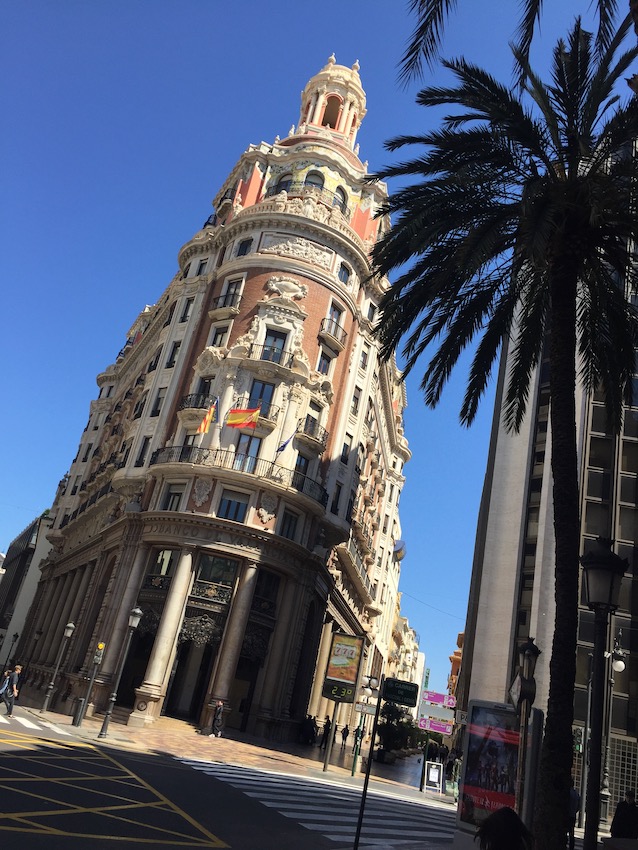
The Banco de Valencia in the heart of the city.
I miss Valencia very much, and I miss Spain. We had a trip to Palma de Mallorca planned for a few nights from Easter Saturday, which will now be cancelled. In a few weeks time, I would normally be writing a post about the smooth beauty and eclectic style of Palma, and our experiences therein, but now I won’t be. 

There should be a golf trip to Mijas/Fuengirola in late May, but this is now unlikely. ¿A quién le importa? some of you might say!

But mostly I miss Valencia.

So many of my social media feeds are dominated by Valencia, Valencian places and Valencian people, that I can never get away from reminders of how much I want to be there. Las Fallas was halted as it was just getting going. For those not acquainted with Las Fallas, its importance as a festival in the eyes of many Valencians is enormous. To have it abandoned (postponed?) a few days before the March 19th climax is akin to sitting the kids down on the evening of December 22nd, and telling them that Christmas won't be happening.

The Valencians are all confined in their apartments. They cannot see their friends. The visitors cannot visit. The amazing bars and restaurants are closed, and their owners and staff will have their own challenges to face. Some won’t be able to survive those challenges.

El Micalet from Calle Corretgeria. We will
never take such sights for granted after this.
All the amazing places of great beauty will go unseen for weeks. The amazing sights, ancient and modern, will go unvisited. I saw agonising images of the Policia Local de Valencia enforcing the closure of the Jardin del Turia. Necessary I know, but it’s painful to think of this amazing space going unused.

On our next visit (whenever this may be) we’ll pass restaurants, bars and shops permanently closed. The same might go for attractions and monuments that have gone without income for weeks or months. These places will have been more than places of employment, more than places of business and commerce… and they will be gone, and little bits of the soul of the city may be gone with them.

Nobody is really to blame, but it looks bleak from where I am right now. I have some understanding of how Valencians view life, and how determined they are to live it! This lockdown will be beyond claustrophobia.

The city has suffered before, and now many will have hardship again. I hope they can draw strength from those past experiences.

My most fervent hope is that I can write later in the year about my first hand experiences of how the city and the people are recovering from this.

For now… buena suerte Valencia. Estoy pensando en ti.


*That’s geographical Europe.

**Don’t start me on that one.


Sunday, 20 October 2019

When the whole is greater than the sum of its parts


2 southern cities, October 2019.

Our Romanian tenants are comfortably ensconced in the Valencia apartment until March 2020. Other than a request to upgrade the broadband to accommodate the demands of their IT work, we haven’t heard a thing from them. According to our letting agent, they’re happy. Which means we’re happy.

And it means that our autumn trip to Spain is a visit to 2 other cities… one an old favourite, and another that we have longed to experience.

Plaza de la Constitucion, Malaga.
After a painless Manchester-Malaga journey, we checked into our modest but perfectly located hotel around late Spanish lunchtime. We hadn’t made any plans for this visit to Malaga. We know the city pretty well. We know what to expect, but as always with Malaga, we expected to be surprised.

None of the cafés at the north side of Plaza de la Merced are the most authentic in Malaga, nor do any of them serve the best food. But many of them are welcoming and accessible at any time. They cater for visitors from all parts of Europe – many of whom may still observe mealtimes particular to their own country.

The nicest surprise as we approached from the direction of the Teatro Romano was to see that the ugly edifice on the eastern side of the square was being demolished. I’m sure this eyesore had once had a name, and a distant memory thinks it might once have been a cinema or theatre, but it was never easy on the eye.

La Alcazaba and Teatro Romano.
Now, with the building part-demolished, you can sit at some of these cafés and see La Alcazaba, the warm afternoon sun defining the fortifications sitting strongly above the Roman Theatre. I have no idea what the plan is for the site, once this monstrosity has been disappeared. Could they just leave it flat, an extension of the plaza, allowing full view of La Alcazaba?

It’s unlikely, isn’t it? I hope whatever plans there are will have sympathy for the area. Plaza de la Merced has descended into a degree of decay before, and needs help to avoid going there again. Any new building on this site must be an opportunity to improve. Optimistically, Malaga is usually good at this, in recent years at least.

With the Spanish summer extending into October, days were starting with crystal clear skies, and reaching beyond 25ºC as the day progressed. Muelle Uno was showing off in the sunshine on the Sunday. A forgettable market at the city end of the quayside gave way to the smart, cosmopolitan, relaxed retail and leisure experience that just gets better and better. The boats moored here get bigger and smarter. Everything seems spotlessly clean and accessible. The restaurants are more professional and welcoming than they perhaps were, and this extends beyond the lighthouse right around to La Malagueta beach, with hundreds enjoying the sun… sunbeds busy enough for August.

Malaga city from the lighthouse end of Muelle Uno.
We enjoyed a great Sunday lunch in beautiful weather. Sunday lunch is an occasion taken very seriously in Spain, and it’s our habit (cuando en Roma…) to take it seriously as well. Despite missing our Paella Valenciana just a little, we enjoyed very good local tapas staples at an unhurried pace among abuelas chasing small grandchildren on bicycles around the restaurant terrace. Aged Spanish couples spotted precious free tables and dived into the seats with practiced precision. The babble of conversation never ceases. A small boy falls of his seat, and at least 2 adjoining tables leapt up immediately to help/comfort/console/start up a conversation about their respective children.

As mentioned in previous posts, to be a child in Spain is to be the star of the show.

As if to remind us it was October, a sea mist drifted quickly in. You could see it coming as you looked down the line of quay, beyond the industrial port and towards the first of the Costa del Sol resorts. It was odd, and slightly eerie, and threatened to swallow up the large passenger ferry across the harbour and flow up Calle Marqués de Larios, perhaps seeping into the marbled lobbies of Massimo Dutti and the Banco Popular.

The sun and the sea mist do battle.
It reminded us both of the sea-frets common to the Yorkshire coast towns and villages of our childhood, but this mist was less resilient than it can be by the cold North Sea. The temperature had never dropped, the sun won the day, and a pin-sharp early evening prevailed.

The title of this blog post was inspired by a lunch. Restaurante El Jardin is a traditional Spanish restaurant, situated on a nice corner where Calle Cañon meets Calle Cister. Calle Cister can be a tide of tourists and taxis at times, but the pretty gardens at the eastern end of the Cathedral give El Jardin’s location a note of tranquillity.

El Jardin won’t win any awards specifically for the quality of its food. The same can be said for the service, which can seem slow and erratic to those unaccustomed to the way it's done around these parts. The décor inside, while charmingly traditional, can only be described as a little dog-eared. They have salsa and flamenco nights, and an old piano sits waiting. The toilets are like, well, you know.

Malaga Cathedral and its gardens
from El Jardin's corner.
But El Jardin has a special place in our holiday folklore. On our first visit to the city, it was the scene of an incident involving the clumsy peeling of a large gambon, and the emergency purchase of an “I ❤️ Malaga” t-shirt from a nearby gift shop.

On this more recent sunny lunchtime visit, El Jardin proved that any place/experience/meal can verify the statement made in the title. We waited only briefly at the bar for a table outside, near to the open doors of the restaurant, and a little away from the tide of guided cruise-ship groups on Calle Cister, heading for the lofty magnificence of the Cathedral.

A competent and enthusiastic pianist was working that old piano hard, his version of Concierto de Aranjuez ringing out. There was a joyous and slightly raucous crowd of Malagueños inside, and it soon became apparent that there was a birthday celebration going on. The diners outside chuckled at the howls of laughter from inside, where the cava appeared to be going down rather well. Our food arrived erratically, and so did the drinks, but they arrived. The small fountains in the Cathedral gardens gurgled pleasantly. We bravely tucked into gambones plancha with fresh lime juice, and a little nod to holiday folklore, and this time got away without any additional clothing purchases.

The pianist reached O sole mio” in his repertoire. At this point, the combination of excitement and cava meant that the birthday party irresistibly burst into song. The Chinese tourists at the table next to them were utterly bemused. Of course, this was immediately followed by Cumpleaños feliz”, and a little more cava. The birthday party eventually broke up with thousands of hugs and kisses, and they all drifted off for an extra-long siesta.

El Jardin felt a little bereft after their departure, but we finished our coffee accompanied by the chatter of the fountains, and reflected on a most enjoyable lunch.

The whole is greater than the sum of its parts.

The following (late) morning, the day before our departure to city #2, we were having breakfast at a café very close to our hotel. The owner brought our coffees, and opened up with the common Spanish complaint about the heat: “que calor!”.

To be fair, she went on to concede that the extended summer had been very good for business, so didn’t want to complain too much. It turned out she was originally Lithuanian, but fluent in Spanish. I’m not fluent, but we managed a decent conversation about the weather, the beaches, the shops (particularly the heladeria opposite, which had benefitted enormously from the weather!) and our respective cities and how they can be a challenge when the weather is very hot in July and August.

So, a Lithuanian and Englishman chatting in Spanish about day-to-day stuff on a pleasant street in Malaga as locals and people of all nations go about their business and enjoy the city around them.

There are people in the UK who think this kind of thing should come to an end.

The great stained glass display
in Malaga's Mercado Atarazanas.
Malaga has genuine, go-to attractions now, but it has retained its character. Perhaps it’s my past experience that makes me feel this way, but it still feels like it has a slight edge… in a good way. The Cathedral and the centro historico around it are clean, characterful and historical. There are great museums, arts, restaurants and shopping. There are spectacular celebrations and processions. La Malagueta beach, and those beyond, are wonderful. Muelle Uno is a triumph. The Ataranzanas market, the Soho district, Castillo GIbralfaro and La Alcazaba are all must-sees. Please don’t just use Malaga as “The Gateway to the Costa del Sol”. It deserves so much more.

The whole is greater than the sum of its parts.

After breakfast at El Jardin the next morning (the coffee won’t win any awards either, but we still love it) we grabbed a taxi to catch our train to city #2. We had never used Estacion Maria Zambrano before, or indeed seen the part of town where it can be found. We walked into a spotlessly clean station concourse which extended as far as the eye can see into an equally sparkling (and unexpected) centro commercial on 2 levels with all the branded shops you could wish for, as well as cafés, restaurants and so on. This is so Malaga.

After a drink at Lizarran, we went through security, joined the queue for the ticket barrier (there was un-Spanish observation of queuing protocol, even when split into 2 lines) and eventually boarded the slightly-late train.

We were finally on our way to Sevilla.

The train slid gently out of Malaga towards the west, then turned north to the mountains. We went through many tunnels, you had little sensation of climbing, but eventually it was obvious that we were travelling on higher ground. There were goats in dusty fields, and eventually everything opened out into a high plain with millions of acres of olive trees, punctuated only by the white scars of surface mines on the hills behind, and the even whiter sparkle of isolated farm buildings.

The train stopped at Antequera, then shortly after at Puente Genil. There was little movement either on or off, as most passengers headed for Cordoba or Sevilla. The olive trees went on endlessly.

Our fellow travellers were:

A Korean couple who would have eaten Doritos and Haribo for the whole journey, if they hadn’t run out. They giggled a lot.

No-one expects... a street to be named after the Inquisition.
A Spanish lady perhaps in her 30s, clearly travelling on business. 2 mobile phones, lots of paperwork, sandwich wrapped in foil. Soon, she was joined by a male colleague in a suit who sat in the seat in front of her. They chatted a little, then he opened his laptop, and they didn’t converse again until Sevilla.

A big English guy in his 60s, with lots of big bags. He squeezed awkwardly past the Spanish business lady to his seat, having only put one of his bags on the racks above. This uncomfortable operation led to him losing his glasses, but once she had helped him find them, all was well.

When the Spanish business lady wanted to eat her bocadillo de jamon, she politely asked him if that was OK. Her English was excellent, and she also gave him some information about where the train stopped, and some advice on finding his way around Sevilla.

An elderly Spanish lady sitting in front of us. She had all the trappings of the elderly Spanish traveller: Small wheelie suitcase, handbag, sandwich, drink, medication, and the ability to fall asleep almost immediately after eating sandwich and taking medication.

The remainder of the carriage made the odd phone call, chatted, coughed, snored a little. The olive trees went on and on, until we started to see larger villages and towns, dominated by spectacular churches, como siempre.

As we neared Cordoba, the countryside became a little lusher, with small valleys and softer hills. The farms looked a little prettier and there were horses and more goats. The line ran through an outlying part of Cordoba that looked abandoned, to be quite honest, but soon the buildings formed into neighbourhoods and then an area that typified those surrounding all the Spanish railway stations that we knew.

These glimpses, and the seemingly austere platforms of the Cordoba estacion del tren, were our only impressions of the city to date. I’m told it’s a fabulous place, well worth a visit, so it’s been added to the list.

The train backed out of Cordoba station, and peeled away to the south, next stop Sevilla. The countryside was attractive on the way in, but soon another Spanish railway station district welcomed us (it could have been Valencia, Madrid, Alicante, Malaga…) and soon we were jumping into a taxi on the forecourt.

The irresistibly cute Hotel de las Tres Cruces.
So, the driver didn’t know how to find our hotel. With a little clarification and a hastily produced SatNav, we got reasonably close. To be fair to him, Barrio Santa Cruz doesn’t allow too many cars in, the ancient streets being barely 1 horse wide in some places.

When we found our hotel, it was in stark contrast to our modest Malaga lodgings. Hotel Patio de las Cruces (named after the 3 crosses standing in the square outside) is a delightful old Sevillano building with 2 cool patios around which the delightful rooms are arranged.

Straight into Santa Cruz for our first sights and sounds of Sevilla. The open doorways in the charming alleys of the ancient Jewish quarter reveal cool patios, and boutique hotels like our own seem to hide attractive rooms and cozy bars. Initial exploration gave way to thirst, and after a drink or two, we were almost inevitably drawn to the mostly tourist-trap-style restaurants on Calle Mateos Gago. The newly-arrived visitor is sadly prone to this. From a nice table by an open window, however, I was able to get a first chance to observe the comings and goings of this tourist-laden street.

I had a reasonable view of Bodega Santa Cruz Las Columnas. This traditional, authentic Spanish café had been recommended, so I hadn’t expected to find it in the centre of the tourist trap. We visited a couple of times… once the next morning for breakfast, and another time on a very busy Saturday to experience the delightful chaos that can only be enjoyed in a popular Spanish café bar. The staff behind the bar (no table service here) take orders and write them on the bar in chalk where you had grabbed your precious square metre of real estate. Their traditional grumpiness fades a little when you order in Spanish (just try a little if you don't speak much!) and soon enough, you’re part of the chaos and laughter. The floor is littered with paper napkins, the plates clatter amid the shouted orders, and it’s just wonderful.

The sun starts to catch
the pretty Plaza el Cabildo.
On our first full day, we set out to get lost. I’ll occasionally use a phone to navigate if going somewhere specific, but we find getting lost is by far the best way to discover things. We discovered the delightful Plaza el Cabildo. We discovered El Mercado del Arenal. At the end of Calle Pastor y Landero, an old lady offering a quick prayer to one of the many elaborate wall-mounted shrines to Santa Maria and told me she does this every time she passes.

Passing much renovation work and lots of very Spanish noise and traffic, we came across the shopping area of the centro. The usual retail suspects were there, but in very pleasantly maintained streets, shaded by cream-coloured roof-height canvases. Passing the Ayuntamiento, we were soon back in the vicinity of the Cathedral, ready for a late-morning snack. Not once had we buried our heads in a guide-book or map and missed what the city actually has to offer. I can do that at home.

Having pre-booked a visit to the Cathedral (recommended to avoid hideous queues!) we sat in one of the more authentic cafés close by and ordered cañas and tortilla. A cockroach bimbled its way up the front of bar and found its prize, the leg of jamon that every café displays, but some are wise enough to cover up. This is no indictment of the café (which was very nice) as they will all fight to control these unwelcome but unavoidable visitors. I just made a mental note not to have the jamon.

Catedral de Sevilla.
La Catedral de Sevilla is astounding. Following a visit to Malaga Cathedral, I wrote that whatever your beliefs, a little time spent in places such as this is a must, but Seville Cathedral is on another level. The outside is amazing enough, although the Giralda tower was undergoing restoration. Inside, there were thousands of visitors, but the sheer scale of literally everything dwarfed the multitude. If the glorification of whatever deity you might choose to worship is more successful if you build it bigger, this place nailed it.

Countless side chapels with innumerable works of art and ecclesiastical treasures, displays of tapestry and clothing ancient and modern (an Archbishops cape from 1547… that’s a 472-year-old piece of clothing) architectural additions to explore, the immense choir and organ, and the main altar that is almost too much to take in. It’s a place that needs more than one visit.

The scale is astounding.
I was starting to get a familiar feeling about Sevilla. Familiar because I feel the same way (although much more strongly developed) about Valencia. It was the feeling that I wanted it all to myself. I wanted the hordes of visitors to go, I wanted us to be there with just los Sevillanos for company, to share the cafés and bars with them, to idly wander the streets with them on the way to the Sunday art fair, to move excitedly with them to see the flamenco at the Plaza de España.

I don’t think the tourists will ever leave Sevilla, however. And why would they? I already knew it was a special place.

That night, we had booked a tapas tour in Triana, across the river from the city. Triana was the original gitano neighborhood, deliberately separated from Sevilla until relatively recently by a lack of bridges, considering itself a town apart. We had chosen the tour in Triana particularly, so that we might learn where to have the authentic tapas experience, away from the tourist melée.

As instructed, we met our guide Marco that evening at the Sevilla end of Puente de Triana, and the small group began to assemble. A young couple from Zurich were already there. Very soon, an instantly likeable 30-something English couple from Kent arrived, followed by an amiable American who now lived in Israel.

Marco (the nicest of guys) introduced himself, told us where he originally came from (Argentina) and why he loved his job, and Sevilla. That bit wasn’t too difficult to work out. We all introduced ourselves, told our own very brief stories, and the 8 of us wandered over the bridge to begin our Triana experience.

The city from the Triana waterfront.
Having explained what’s involved with an authentic tapeo experience, Marco led us to the first bar, one street back from the Calle Betis waterfront. We enjoyed a crisp Manzanilla with charcuteria. When salmorejo was mentioned, I commented that we had enjoyed some for lunch. A few minutes later, as we enjoyed a new tapa of salmorejo on toasted bread with jamon shavings, the female half of the Zurich couple leaned towards me and hissed: “we all had lunch, you know”. One or two pairs of eyes looked up from the food, but we let the moment pass.

The next bar was one of those where discerning tapas diners wait for it to open (como Casa Montaña de Valencia!) as the tables fill instantly. We occupied our 2 tables just before opening time, and Marco explained that many tapas paired particularly well with certain drinks. In this case, shrimp and ice-cold beer. Shrimp and picos duly landed, and Marco was right. They were a challenge to peel for our unpracticed fingers, but delightfully sweet and the beer was the perfect accompaniment.

But our friend from Zurich didn’t like beer, and had to have white wine. Which she spilled. Her partner’s discomfort visibly increased.

Marco took us down the incredible “ceramics street” in Triana, where the beautiful azulejos decorate every building. He explained why sangria is not always a good choice of drink. Quite difficult to mix successfully, and too often served from factory-mixed product, the better option was a drink favoured by most Spaniards. Tinto verano is a simpler (and surprisingly refreshing) mixture of red wine, lemonade and fresh lemon, although recipes vary, as with so many things. We would enjoy it in the next bar, with amazing tapas of garlic mushrooms and small, tender pork steaks on bread with fried potatoes.

Except that our friend from Zurich didn’t like tinto verano, as she preferred sangria. But she wanted white wine. She had a device that attached a small bottle of water to her handbag. Just saying.

In the last bar, just down the street from the first, we sat down to give Marco a chance to have a drink and chat a little. We enjoyed a heartwarming Rioja, and deep-fried aubergine with a honey glaze. Having told Marco at the outset that she couldn’t eat peppers, our friend from Zurich wasn’t given the final tapa, a generous offering of pork cheek in a wine sauce. Marco had played it safe, as peppers would have been used to make the sauce.

She was given spinach croquetas instead, but didn’t like them. She complained that she wasn’t getting the pork cheek, despite Marco’s explanations. I offered her some of the pork cheek that was nearest me on the table, but after picking at it, she claimed that she needed to eat some vegetables. She wouldn’t eat the aubergine, which was most assuredly a vegetable last time I checked.

She was getting embarrassing, and she and her partner had a conversation in German. He had an imploring tone, she an indignant one. The fact that the tapas tour hadn’t been tailored to her specific personal needs and wants seemed to be the problem.

Marco’s professional approach to the whole thing seemed to be tinged with a little relief when the tour was over. It’s likely that he gets some difficult groups and individuals, but it must be unusual to try to accommodate someone who is determined to not enjoy it.

But it was an enjoyable evening, although perhaps not a coming together of nations in unconditional friendship. But these things are all part of the experience. Because, as we now know:

The whole is greater than the sum of its parts.

We went for a drink with our new friends from Kent, in a spectacular rooftop terrace bar overlooking the Cathedral. We saw them by chance on a couple of other occasions. Another day, we bumped into Marco at an amazing celebration of Hispanic food and products in the park close to the Plaza de España.

We went back to the first bar of the tour for more of their amazing food and manzanilla. Another Tapas Tour came in, all Americans. The guide appeared to have a group who only wanted to talk about themselves, and not learn about the food and drink. Maybe it’s not such an enviable job.

The Alcazar de Sevilla. The detail is amazing.
The 2nd big attraction in Sevilla is The Alcazar (again, pre-booking is good). This Mudéjar palace built for Peter of Castile is an eclectic mix of styles, once again notable for its scale and incredible detail. Built on the site of a Muslim residential fortress, the ornamental gardens go on forever, and you can get lost in the maze of rooms (and we did) all decorated with the most incredible craftsmanship and artworks. Most of the first floor remains one of the Spanish Royal Family’s many residences. 

But a lesser-known piece of history was perhaps even more fascinating. I had come across the Palacio de la Condesa de Lebrija while doing a little pre-trip research, so we visited on the morning of Dia de la Hispanidad. If you can see past the astonishing amounts of money spent on this palace over the years, it’s quite a sad story. 

Dating back to the 16th century, this incredible house was bought by the Condesa de Lebrija in 1901, 3 years after the death of her husband. With a passion for archaeology, she then proceeded to restore and reconstruct the palace using a priceless collection of antiquities imported from all over the world. Entering on the ground floor, you walk on Roman mosaics that pave almost the entire floor. On the first floor, a young guide (in perfect English and Spanish) talked us around the astonishing treasures that the Condesa had collected, only to be enjoyed by her grieving, lonely self. The Spanish visitors listened intently to the Spanish descriptions, then chose to talk over the English ones. Bless ‘em.

Just a tiny part of the Condesa's
incredible collection.
This may be a lesser-known Sevilla attraction, but it’s a must-see. Precious because of the treasures within, but also because it may never have been seen at all if the descendants of the Condesa hadn’t eventually chosen to open the palace as a museum, as late as 1999. 

But it was Dia de la Hispanidad, the national day of Spain, and Los Sevillanos were dressed in their best, ribbons of red and gold pinned to their lapels. We had lunch opposite the university on Calle San Fernando. There had been a celebratory function in the old University, and the guests poured out in their finery, all high heels and perfectly styled hair, kids in smart shirts and chino shorts. Laughing, heading for a long lunch. 

It was hot in Sevilla, quite a lot hotter than Malaga, but a second visit to the Plaza de España was planned after lunch. I have to admit this incredible place was an irresistible attraction. On our first visit a couple of days earlier, we had not only enjoyed the incredible construction, built for the 1929 Ibero-American Exposition, but had been privileged to see a performance of what appeared to be authentic flamenco by a group entertaining the crowds in the shade of the pavilion at the centre of the huge sweep of the building.

The Plaza de España. Amazing.
The male dancer built his intense performance into one of real drama, the singer and guitarist reacting to his movements and emotions, rather than vice-versa. The palmas were provided by the singer and a female dancer waiting for her own performance. 

There were some in the audience who appeared to be aficionados, and each break in the dance was greeted with loud applause and shouts. I know of the word “duende” which refers to a heightened emotional state sometimes reached during a flamenco performance. I don’t know if that’s what we were seeing, but it was certainly intense. 

It was a relatively short, but genuinely fulfilling introduction to flamenco for us. The thought of booking a ticket for a performance where chairs are formally arranged around a stage for a rehearsed show now seemed unattractive to us. We felt we had seen the real thing, and gave generously to the hat that was passed round. 

A little part of Valencia in Sevilla.
The second visit to the Plaza de España didn’t have flamenco, but the place was no less spectacular. Around the great curve of the structure, all the Spanish provinces are individually depicted in azulejos, so we naturally visited a tiny bit of Valencia in a beautiful park in Sevilla. 

As our visit drew towards its end, we took to the streets again on our last full day. While we had a destination in mind, it was the slow and easy wandering that led us to more discoveries. An amateur art fair outside the Museo de las Bellas Artes. Astoundingly wonderful architecture around every corner. The quiet Sunday morning streets, church bells occasionally reminding the faithful to shake off their hangovers. A market on the Alameda de Hercules. The buzz of an awakening barrio Macarena, families beginning to gather again at the bars alongside Mercado de la Feria where we stopped for a cold caña. Passing through the Arco de la Macarena, we turned within sight of the Parlamento de Andalucia and headed back to town. 

There are hundreds of churches in Sevilla, and it felt like we passed most of them. Passing into Santa Catalina, we wandered into the delightful Plaza los Terceros, where families with younger children were starting to gather for lunch at the tables under the trees. After another drink break, we wandered on, and were soon back in centro.  

A tranquil stretch of the Rio Grande.
The rest of our visit passed with a last visit to Triana, and an idyllic couple of hours spent by the Rio Guadalquivir, or the Rio Grande as the locals like to call it, a nod to the enormous part it played in bringing riches from the new world back to Spain. North of the Puente de Triana, the river banks become tree-lined and feel much more rural. There are riverside parks where families cycle, walk their dogs or pass by on the now ubiquitous electric scooters. You lose the sense of being in a city, much like you can in Jardines del Rio Turia in Valencia. The weather was flawless. 

All of the above delights are the achingly attractive parts that make up the whole. We left Sevilla with much remaining to discover, but we already know that we'd been lucky enough to spend time in a very special place. 

The whole is greater than the sum of its parts.  

As we left Sevilla, taking a last look at the great sweep of the Guadalquivir, the bridges, the barrios, and the great monuments from high above, I didn’t feel the emotional wrench I still feel when leaving Valencia. 

But with a couple more visits, all that could change.  


Dedicated to a great friend.
A life too short, but undoubtedly well lived.