Sunday, 28 July 2019

What are the true colours of Altea?

¿Cuáles son los verdaderos colores de Altea? 


So, the first visit to Spain since our 2019 Easter in Valencia1. We now have tenants in our Valencia apartment until March 2020, so we looked for a new venue, and rented an apartment for a couple of weeks in Altea, a small southern Costa Blanca resort town in Comunidad Valenciana. 


Puerto Altea with its backdrop of the Sierra Helada.

We had some expectations of Altea. I had visited with my work some years before, and remembered it as a quiet, pretty place, made up of a traditional old town on a hill and a resort promenade, beaches and harbours. The apartment promised much when booked, overlooking Puerto Altea with a vista of the whole bay. The whole of Altea lies very close by to the east, and then Calpe at the end of the bay. The infamous Benidorm lies 10km in the other direction. 


This is the time of year we take our 2-week holiday and spend it on the beach. Cultural exploration is not a high priority, but relaxation is. Tourists, on a beach, away from the grey UK.

Altea old town stands prettily on the hill.
Altea proved to be a very interesting choice. 

For the sake of this post, we can say that Altea comes in 2 parts. There is a traditional old town, dominated by a church perched on a hill looking over the bay. And there is the coastal area, consisting of several beaches, harbours, a long seaside promenade with many restaurants and bars, and some larger hotels out of town towards the north east.

The old town and the seaside are are (broadly speaking) divided by the N332 road. 

It’s from the beach that you notice the colours the most. In terms of the provision of colour in these parts, the sea leads the way. Looking directly out towards the east, the horizon is a constantly sharp divide between sea and sky. Here, the sea is a vibrant cobalt blue, flecked with high-contrast white on a breezy day. As your eye drifts around the bay, and towards the shore, you take in several shades of blue/green, each as vibrant as the next, and constantly changing.

If I was painting it, I’d probably stick to 5 different blues, but you would need to mix your paint well to give them all due respect. These colours run through an amazing spectrum, but nearest to the shore is the most enchanting colour, a Caribbean-level azure/turquoise that isn’t found in too many European waters. When the sun gets to a certain place in the afternoon, that uniquely Mediterranean sky combines with all of these other blues in an awesome display of colour. 

The iPhone camera cannot do the colours justice!
And so to the beach. Playa de la Roda, where we spent almost all of our days, is a beautiful white pebble beach right in front of Calle San Pedro, the beachfront promenade. A pebble beach will not be for everyone, but there’s a lot to be said for it. 

Sand is not in the conversation. It’s also not in your food, drinks, clothes, eyes or hair. It doesn't blow over you on a windy day, and won’t be removing your skin as it does. Because there is no sand, that azure/turquoise is crystal-clear as it laps the shore on a gentle
Mediterranean day. The pebbles chatter in the small breakers. With closed eyes, you can hear the whoosh-chatter of the gentlest of firework displays.

Hugo (whoever he is)
enjoyed the beach as well.
Don’t get me wrong, if you offered me 2 weeks on the vast, sandy expanses of Valencia’s city beaches, I’d bite your hand clean off, but the white pebbles of Playa de la Roda were more than a pleasant change. 

Sitting on that beach, looking out to sea, I got a pleasant sense that Altea and surroundings came as a neat geographical package. That well-defined cobalt horizon forms the straight line of a half circle, it’s end points being the peak of the Sierra Helada to your right, overlooking Albir and its own bay, and Calpe to your left, dominated by the magnificent Peñon d’Ilfach. The rocky crags that tower above Altea’s old town form the curved side of my imaginary half circle, clouds often smothering their peaks in the mornings, only to succumb to the sun on another pin-sharp day. 

Peñon d’Ilfach towers over Calpe across the bay.
The sunbed operation is managed by the Ayuntamiento, and is efficient but a little expensive. It felt like a stark contrast from the ultra-laid-back operations on some of the Costa del Sol, often operated by the nearest Chiringuito. In Altea, a not very laid-back guy would appear soon after you’ve arrived, and politely (but stiffly) request payment. He often argued with customers over the prices. We understood that he was just doing his job, but to say to people relaxing on a beach “this area is closed at 7pm, and the umbrellas come down at 6.30pm” seemed a little Soviet Russia, if you ask me. 

A little bit Riviera?
Seen from the beach, the Calle San Pedro promenade has a little feel of the Riviera2 about it. The apartment buildings above the bars and restaurants bring their own colours. Sunblinds drawn down to keep the apartments cool have their own happy shades of emerald green, orange and coral. The skillfully shaped shade trees along the beachside part of the promenade give natural greens, and the clean walkway and benches a shining white.

A clean, white promenade walkway.
This promenade runs from a very good Mas y Mas3 supermarket, all the way to where the beachside villas start half way along Nueva Playa de Altea. As we walked along on our first night, my heart sank. The comparison with Fuengirola beachfront was very hard to ignore. There was a bar called “Sands” where disgruntled/drunk UK immigrants4 griped over their drinks. Ditto “Rascals Bar”, a little further on.

I shouldn't have worried. Fuengirola seafront is smothered with every kind of Brit-themed food and drink outlet possible (and yes, that does include pizza) rendering it simply distasteful5. In this part of Altea however, you don’t have to look too hard for traditional Spanish and other more cosmopolitan choices. There were a few very nice places to eat and drink, and towards the end of our visit, we reckoned that we had chosen well, on the whole. 

On our first night we found Ca Jaume, a nice Spanish/Valencian place with a simple menu. The staff try to improve your experience, not just bring food. The tapas staples of ensaladilla rusa, croquetas and albondigas were excellent. The house rosado was delicately pink, but drank a little like a very light Fino. We went back twice during the holiday.

A pretty old town, but muy turistic.
And so to the old town. We took a taxi, and I asked to go to Plaza de la Iglesia, the heart of the old town dominated by La Iglesia De Nuestra Señora Del Consuelo. The driver grumbled his way through an explanation about pedestrian streets, and how he would get us as near as possible. At the end of a grumpy journey, he grumpily accepted my euros. We walked through delightful old town streets towards the church, its startling blue domes sparkling with the same blue as that cobalt horizon. Reaching the pretty church square, we took in the breathtaking view from the mirador, and relaxed with a cold drink with a view of the church and craft market. 

The drawback here was that we did this in the company of 400,000 other tourists.

A large group of Spanish kids, all in bright green camisetas, sang and chanted on the church steps while their “supervisors” drank beer next to us in a bar. Hundreds of pink people with expensive trainers and bad attitudes tramped backwards and forwards across the square, no doubt searching for branded fast food outlets, which were mercifully absent. They bought "crafts" from the "craft stalls" set against the church walls instead.

There is no doubt that old town Altea is beautiful in itself, and I’d love to visit when much, much quieter. It was such a shame that we didn’t really want to stay, and took the cobbled streets and steps on foot, back down to sea level.

Is it any consolation that even before Altea was discovered, the church square would have been full of merchants, stallholders and visitors from the surrounding farmland? Wouldn’t it be heaving with people at certain times throughout history in any case? Is this really any different? 

Sorry, it's no consolation, I’m afraid. It’s tourist trap, and we were complicit.

We came across a few colourful characters. There appeared to be a small group of heavy-drinking immigrants (possibly a mix of Brits and Northern European) who seemed to spend their days abusing/being abused by various locals and visitors. We escaped their attentions, but saw one fall all over the table where a nice Irish couple were enjoying their tapas. He overdid his apology and made it all worse, as is so often the case in such circumstances. He reeled precariously over our table before guiding himself to the next bar, where he appeared to repeat the whole sorry process. 

Another of this group was warned away from the newly-opened Ocean Lounge by the owner, shouting “we are closed to you” across the street to him.

This owner of the Ocean Lounge was an interesting character. It seemed that the place had only opened around the day we arrived in Altea, and the mission was obviously to provide a high-end experience. The building was all sparkling white and aquamarine blue. The staff walked on eggshells, trying to make everything Marbella-coloured and pristine. El Jefe dressed in a dirty polo shirt and ill-fitting shorts in contrast to their smart chino-and-white uniforms. He was all over them like a rash, and was in the process of micro-managing them into oblivion. When we asked for the bill on our first visit, the staff got into a confused huddle, decided they couldn’t manage this, and asked the boss to help them out. I’m sure it never occurred to him that this was his fault, not theirs.

By contrast, the hosts of Hotel Restaurante San Miguel made our experience amazing. This place had been recommended for paella, and it was so popular that our mid-holiday Sunday lunch had to be taken on a Monday. We sat among locals (I didn’t see/hear any other nationalities in the packed-out place) and had our customary paella experience. I’ve had better paella (although it was good) but the hosts made the experience a special one. The host Pepe is a genial, friendly, hand-on-your shoulder man, who welcomes you as if you’ve been eating there for 20 years. 

His wife fussed and bustled around us in the nicest possible way. She was like a Mum who wanted everything to be just so, and I’ve never seen anyone so happy, and with so much energy at the end of a long lunch shift as her. It also rubbed off on their younger staff. 

We went back for dinner later in the visit. With 3 simple dishes of grilled red Denia prawns (possibly the best ever) grilled lamb chops and grilled swordfish, Hotel Restaurante San Miguel became our Altea #1.

The building is an old-school Spanish hotel, founded as the tourist boom arrived in the 60s. The walls are hidden by a thousand paintings by artists attracted to Altea over the years by its incredible light. A trip to los baños takes you up 2 flights of stairs, past a thousand more paintings of all subjects, and a cosy residents lounge with piles of paperbacks and yet more paintings. A clandestine tip-toe along the hall brings you to an achingly attractive residents restaurant overlooking the bay.

Along with the sunbed guys (not a barrel of laughs), the odd busker (one so bad, it wasn’t even funny), the homeless guys with their collection of dogs large and small, and the general local population of Altea, there was the population of visitors, of course. Firstly, there were mercifully few Brits6. There were a lot of Spanish tourists, some French, some Scandinavian, some Russian, but the majority were from The Netherlands. There were Dutch-themed cafés, bars and restaurants. There were more Dutch translations that any other nationality.

I like the Dutch. I have had the pleasure of working with some Dutch people in the past, and find them friendly, organized, determined and freakishly good at languages. The legacy of a great seafaring nation perhaps? The holidaymakers and immigrants from The Netherlands in Altea were no exception. We saw families not only check the menu, but do a full recce of a restaurant before they were satisfied that they were going to extract full enjoyment from their meal. On the beach, they were respectful of proximity (not always the case with Los Españoles), were not going to enjoy themselves at the expense of other peoples’ fun (not always the case with the British). On the whole, they were calm and relaxed.

What I fail to understand is why the Dutch are particularly attracted in such great numbers to Altea. Of course, this could apply to any given nationality and any given resort. What was the trigger? What attracted that particular group of people to that particular place? More questions than answers, as ever.

Nice traditional touches outside an
old beach-side villa.
The last word must go to the varadero. From our apartment balcony, we had a perfect view of the activities of the Club Nautico de Altea boatyard. Boats of all shapes and sizes were brought to a slipway and lifted out of the water. They were steered, suspended from what I now know to be called a “travelift” by an immensely skilled remote control operator, with inches to spare, into their designated place. The yard was full when we arrived mid-July, but was emptying as we left, boats now ready for the August holiday. Cruisers up to about 50m, yachts, fishing boats, smaller speedboats, and every other craft imaginable were repaired, serviced, painted, cleaned and then relaunched. One or two seemed to be undergoing the kind of refurbishment that would not see them ready for the month-long August holiday.

What was obvious was the skill and craftsmanship of the workers on this boatyard. We could see that the permanent staff, many working from 8am-8pm as far as we could tell, were supplemented by other specialists as required. It was a fascinating operation, and we found ourselves mesmerized by the goings-on several times.

I think what was special about this was the insight. If we had only had a view of the marina and the Club Nautico de Altea, it would be too easy to assume that boats simply glide to and fro at the whim of their owners, and all is sparkling blue sea and sun-tanned yachting-folk. The varadero was a constant vision of reality, of what lies beneath the gently lapping waves, behind the veneer.

Looking towards Calpe.
As if to reinforce this, a small fishing boat was brought in towards the end of our visit, looking a little worse for wear. Its engine was removed and hauled away. Work to restore it to its working state was underway for many hours a day. This was someone’s livelihood, alongside the pretentiously-named and carelessly-owned Sunseekers and sleek yachts.

This was a good holiday, and it was good to experience a new destination. One can’t compare Altea to Valencia, so I won’t even try. There is no doubt Altea is very easy on the eye. It has other-worldly colours and incredible light to make those colours sing. It has charm and the real commitment of some to keep it genuine.

But I’m not sure how I feel about Altea yet. Is it too close to Benidorm to resist its “charms” for much longer? Will it become yet another Northern European enclave? Will Rascals Bar beat Ca Jaume in the competitive world of “what the visitor wants”. Will the seagulls on the beach become a problem? The answer to that one is yes, but only if people keep feeding them.

What are the true colours of Altea? Time will tell. Buena suerte Altea.

With a much-anticipated Malaga and Sevilla trip coming up in October, we settle back in to the grey UK for the moment. We hope the grey people in their grey suits don’t block all of the light out.


1 Technically untrue. The annual boys’ golf trip to the Costa del Sol had taken place in May. I cannot imagine for one minute that the exploits of 8 middle-aged men in the Mijas/Marbella golf Valley are of any interest at all to you, the discerning reader.

2 I’ve never been to the Riviera. I’m just saying that the promenade makes me feel like what a promenade might make me feel like on the Riviera. Anyway, I’ve seen pictures. D'accord?

3 We called in every morning for all the (unfeasibly cheap) ingredients for lunch on the beach. And most evenings for all the (unfeasibly cheap) ingredients for a drink on the balcony.

4 I refuse to call these people “expats” any more. I have no doubt that if they were in the UK, and a Spanish family moved in next door, they would call the Spanish family “immigrants”.

5 I have to say that the area around Plaza de la Constitucion in Fuengirola is delightful.

6 I’m sorry. Where the British holidaymaker is concerned, I’ve often come across as a hater in this blog, despite sometimes being a holidaymaker myself. And I don’t want to tar all Brits with the same brush. But it’s the attitude. It’s the “where’s the Irish bar”. It’s the “where can I get an English Breakfast”. It’s the surprised moan of “this menu’s all in Spanish!”. It’s the disdain for anything that’s different and special about a foreign country and its culture. Rant over, for now.


Sunday, 28 April 2019

Los árboles

We left the UK on Easter Saturday as it enjoyed warm sunshine and clear skies. For once, the weather was against us. We arrived in Valencia to strong winds and rain, and news that further down the coast in the resorts around the Marina Alta, there were storms and flooding.

A city of trees.
From the modest streets around our apartment to the most elegant stretches of the Gran Via, Valencian streets are lined with trees. Towering palms, Jacarandas, and of course, the ubiquitous but delightful orange trees in their thousands. Many had succumbed to the wind on this Easter weekend, and were down or damaged in many streets and in many of the parks and gardens.

A huge palm had fallen close to the southern end of Calle Reina in the Cabañal. As it lay there across a small plaza, it silently vindicated the sad decision made by the Junta de Semana Santa Marinera – an 8am meeting on the morning of Domingo Santo had decided to suspend the Desfile de Resurrecion.

Falling palm trees and Easter Parades don’t mix.

The Desfile de Resurrecion.
Easter parades in the Cabañal... but not this year.
All of these trees would need to be replaced, and this put me in mind of a famous quotation: 

“A society grows great when old men plant trees in whose shade they know they shall never sit”.

There are many variations and attributions of this phrase, but the particular version above has mostly been attributed to the ancient Greeks. And yes, I’m aware that the phrase is less than politically correct.

What’s important is your own interpretation of it. For me, it’s about legacy. Selfless legacy intended to benefit others. I imagine the originator of the phrase expected the (metaphorical) trees to be planted quietly and without fanfare. There should be no vanity or reward for the "planters", just the legacy left for those who follow.

Don’t we seriously need some of this shit right now?

With the current situation in the UK and Europe, I can’t help but think of politics. This blog was never intended as a place for political discourse, but bear with me for a paragraph or two, and I’ll get back to Valencia very soon.

The horrendous shambles of Brexit has been “driven” by those thinking only of a legacy that will benefit themselves. Whatever they have done has been driven by their hunger for career, power and money. I hope only for the demise of the whole notion.

The same goes for the disturbing rise of the far right in both Europe and across the world. This is led by those who attract the poorly-informed and the easily-led. They put them to work to push themselves towards more power and more money. Those that follow such leaders will suffer with the rest of us. There will be precious little shade for anyone if they succeed.

And so to Valencia. In 2015, Mayor Joan Ribo picked up where Rita Barbera had left off. Her terribly corrupt regime cannot have been an easy one to follow, and Ribo deserves credit for that alone. Few Valencians, however, will confidently state that corruption will never taint Valencia’s politics again.

Avenida Constitucion. The new cycle lane
on the right hidden by more parked cars.
Where legacy is concerned, Ribo has focused on the bicycle. His legacy will be the huge operation undertaken in the city to provide an extensive network of safe, separated cycle lanes. The benefits are obvious, but there is fallout. With limited road space, many roads are reduced from 3 lanes to one or two, where additional parking and the cycle lane have been added. We have seen this on our regular walks down Avenida Constitución

Does this reduce traffic or increase congestion? I guess this depends on who you listen to. Cyclists (12% of residents) are safer and happier, but car drivers claim an increase in the huge traffic jams endemic to Valencia, alongside a possible increase in pollution from idling traffic. Pedestrians aren’t always safe from cyclists, and the now popular electric scooters or patinetes are not only fast but completely silent.

The cycle lanes will be Ribo’s legacy. The money and time spent may have been diverted from other areas… I have speculated on the poor state of upkeep of some historic buildings in previous posts. Spanish politics will perhaps never shake off it’s corrupt reputation, and so Ribo will no doubt be accused of sitting in his own self-created shade in years to come.

His party, Compromis, had raised various temporary structures around the city, trying hard to be visible. Everyone was electioneering in the lead-up to Spain’s general election happening as I write on April 28th. The TV was awash with political debate. No doubt Valencia, as a left-leaning community will try to resist the march of the right wing and vote accordingly.

Vox is a right/far right political party with some seriously poisonous views. A small group of supporters were meeting in a restaurant at the Marina on the last day of our visit. Their advanced age and demeanour suggested that there wouldn’t be an actual right-wing uprising by the sea today. Probably just some paella-eating with an unhealthy serving of blinkered prejudice on the side. Not much tree-planting there.

So let’s talk real legacy. Whoever insisted that the dry river bed of the diverted Rio Turia was turned into a beautiful park was thinking genuine, selfless legacy. Following the final, devastating city flood on 1957, the river Turia was diverted south of the city and the dry riverbed was left. The city’s first idea was to turn it into a huge highway to relieve traffic congestion. But the people pushed back… “the riverbed is ours, and we want it green!”

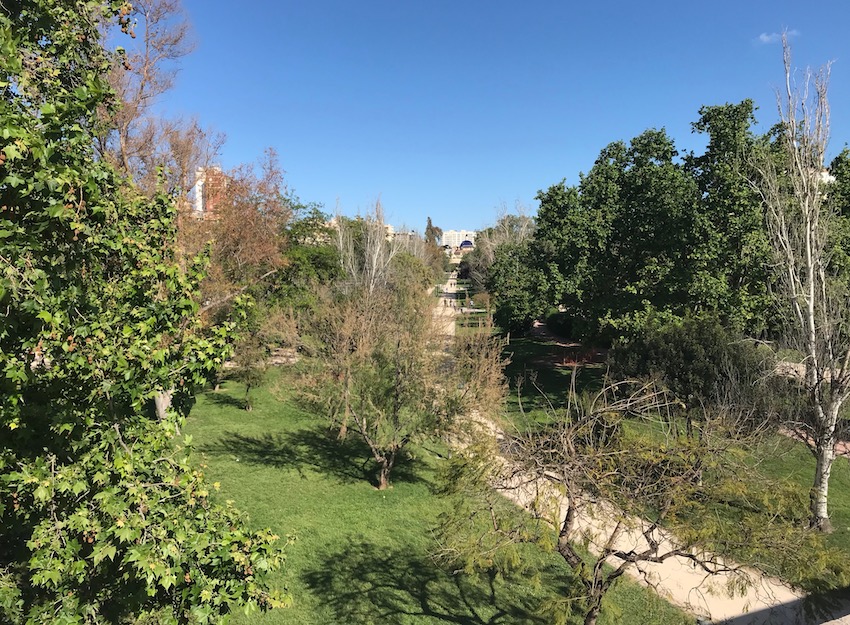
The part of Jardín del Turia that spans our area, La Saidia.
From Puente San Jose to the Museo de las Bella Artes,
its blue dome just visible in the distance.
It’s the thing that most Valencians will talk about when asked what is great about the city. Today’s Jardín del Turia is a 9km green belt running from the Parque de Cabecera in the west, to the incredible City of Arts and Sciences in the east. It’s crossed by 18 bridges, many of them historic monuments in their own right, and provides endless recreational facilities. There is too much to describe here, it has to be seen to be believed.

Most importantly, it’s accessible to all.

If some analyst came along and broke down any legacy into tick boxes (they would probably be called “fulfillment criteria” or something) in order to judge it on its effectiveness, the Jardín del Turia would tick them all. It’s just magnificent. It’s one of the things that defines Valencia.

One particular thing that we notice in La Saidia is how the South American community use the park, particularly in the evenings. We regularly see them gather in big groups of several generations, and barbecue and enjoy each others’ company into the night. The one no-no of the Jardín del Turia used to be going down there at night. The Americanos have pushed back on that, and it’s great to see.

The Valencian weather inevitably returned to normal after Easter Monday. A few gentle showers led to the return of shimmering sunshine from perfect skies. Spring weather in Spain is the sweetest, if not the most reliable. In between getting the apartment ready for a longish rental to start in May, we enjoyed the best of the city, as it would be our last visit for around a year.

Mercado Central was as fascinating as ever. Despite the hordes of visitors, we collected some produce direct from the Valencian huerta to take back to the UK… hopefully to last a year. We count ourselves immensely fortunate to be able to enjoy the great food that the city offers. A first visit to one restaurant close to the Ayuntamiento found it unpretentious but, at the same time, nothing less than a quality experience. The owner’s Grandmother had moved to Valencia from Amsterdam in 1951 and opened the restaurant, and had left her legacy of quality and service. An old favourite close to Plaza Doctor Collado hadn’t lost any of its typically Valencian warmth and welcome. And, of course, there was paella.

As the week came towards the end, we enjoyed the beautiful weather at the Marina Real Juan Carlos I (despite the Vox pensioners) and the thousand-acre beach starting at Las Arenas. The sand had tried to reclaim the beach front promenade in the Easter weekend winds, but had now been cleared, and the 2 iconic flags at the Marina end of the beach were being replaced after the ravages of the winds.

Las Arenas, and the return of Valencian weather.
The beach and port part of Valencia will soon be back to it’s best after the winter. Many Valencians consider the Marina to be an expensive white elephant, developed at great expense for a short series of events that will never be repeated. The view is that it has never effectively exploited since then. I kind of see what they are saying, but I pay my taxes also. I think it has the potential to be another great legacy. 

Perhaps Joan Ribo’s successor will pick on this as their obsession?

There is no shortage of legacy in Valencia, of course. The ancient city has preserved a great multi-cultural history and incredible architecture. There are great seats of learning and world-renowned craftsmanship, particularly ceramics. More recently, sport and the arts have flourished, and the creative scene continues to bloom. Valencia and the region is quite deservedly a culinary magnet. Its street art is extraordinary, particularly in the Barrio del Carmen.

The Portal de Valldigna in the old city.
It once marked the boundary between the
Christian and Arab parts of the city
All of these things need preserving, as they often seem fragile. Legacies for the future, we hope.

It’s never easy to leave. It’s the last Saturday in April and the weather is beautiful. City workers are planting new trees in the streets where the wind removed the previous ones. The wind-blown debris has been cleared, and the streets look smart.

We won’t be back for almost a year, perhaps in March 2020. We’ll most likely miss Fallas in 2020 as well.

Again.

But happy travels in Spain are planned before then. To the Costa del Sol in May, a return to beautiful Altea in July... and hopefully Sevilla in the autumn.

Plenty of time to think about legacy. I think we can all take the time to think about legacy. Can we do something? What can we grow? What can we plant that leaves things just a little better than they were when we found them?


Tuesday, 1 January 2019

Estamos todos en un viaje


Valencia isn’t easily accessible from our part of the north of England, at any time of year. Part of me hopes there will always be a few challenges in accessing Valencia from the UK. Even now, with the "easy city break" culture that so many people enjoy, Valencia retains something unexplained, something unique, something secret that I don’t feel in Alicante or the Costa del Sol or the more accessible (and therefore more crowded) Barcelona.

For all its provincial limitations, our local airport in the UK is convenient. But there are no flights to Valencia. When we use this airport, we fly to Alicante and take the train up to Valencia, carefully working out the times of flights and trains, and crossing fingers that there are no delays with either.

The journey is a fascinating part of the trip if you’re prepared to absorb it. Take in all of its many interactions, experience it, and enrich yourself from the whole series of small events.

The flight to Alicante was uneventful. The vast majority of our fellow travelers were headed for Alicante itself, or for Benidorm, of course. Many of the throng had enjoyed a breakfast-time lager in the terminal, but the flight was quiet… we had all been up early.

We grabbed a taxi to Alacant Terminal, and with time to spare, enjoyed a beer or two in the sunshine outside the excellent cafés at the railway station. The snarled traffic outside the station beeped and gesticulated as the weather sparkled.

As the train departure time approached, we passed though security and walked right to the edge of one of the widest cultural chasms that exists between the UK and most of Southern Europe.

Queuing.

The Spanish don’t really see it the way we see it. The protocols around queuing that exist in the UK are similarly observed in Spain, right up to the point where they can’t be arsed to observe them any more, and whole thing breaks down. For Brits (still including ourselves) this takes a bit of getting used to.

The queue snaked back from the booth where they check your tickets, and here, everything was fine. Our delicate queuing sensibilities were satisfied by the gently waving line that had already formed with the magical, shining portal to the Valencia and Barcelona train at its head. These queuers (?) had done well. But latecomers were confused by the need to double back to join the back of the queue, so just joined where they felt appropriate. Soon there were a number of tributaries to the queue river. In the UK, a tributary would never have been allowed. Not ever.

In the UK, the most confident/indignant member of the queue would snarl: “Back of the queue’s there mate” or something along those lines, perhaps accompanied by some eye-rolling and a face slightly flushed with frustration. Here, there was confused muttering, some elaborate hand movements and some tutting… but none of it was directed outwards, it was just another topic of ceaseless conversation within groups.

As if sensing the tension, a RENFE employee announced that there were now 2 ticket booths open, so 2 queues should be formed.

Not the best idea she’s ever had. The queue clearly thought she’d said: “everyone please rush the ticket booths. I repeat, please rush the ticket booths”.

There were a brief few moments of carnage, one or two smaller travelers were crushed under massive wheelie suitcases, but eventually something like 2 ragged, non-UK-style queues naturally formed.

We all had tickets, after all. We weren’t queuing for the last 10 loaves of bread. And nobody actually got crushed, I made that bit up.

We watched the dusty, yellow land north of Alicante slide past as we started towards Valencia. Darkness fell early at this time of year, so we knew that the enchanting sights of fairytale castles perched on seemingly inaccessible crags and mountain-tops would have to wait for the return journey.

We dozed a little, along with the rest of the carriage. The comfortable train continued to slide effortlessly northwards. Before too long, a huge IKEA logo told me that we were passing through Massanssa, just south of Valencia. Buildings soon became recognisable, and we pulled into Estacion Joaquín Sorolla only slightly late. 

Queuing problems at Alicante, apparently.

“We leave something of ourselves behind when we leave a place, we stay there, even though we go away. And there are things in us that we can find again only by going back there.”  
Pascal Mercier, Night Train to Lisbon

There were some changes in the apartment. Our rental agent had made sure to have jobs done in time for our arrival… a little painting, one or two repairs. We reconnected with the place quickly, with the things we had left there, the things that welcomed us back.

Torres Serranos. The last spectacular sight to enjoy
before the old town takes us in.

Out into the mild December evening for the happy little journey into the old town. All the familiar sights along the walk. Where to go, what to drink, what to eat. There is so much to offer, and we are so lucky to be able to enjoy it.

The next day, we took the tranvia to the beach. Marina Real Juan Carlos I and Paseo Maritimo, to bask in sunshine with a beer and to anticipate the Paella Valenciana to come is now customary. The paella didn’t disappoint.

We always relish and appreciate this treat to ourselves, but is this the real Valencia that’s experienced and lived in by “normal” Valencians?

No, it isn’t. It has nothing to do with their everyday struggle with utility bills and IBI tax, nothing to do with what they have to pay when the lift needs servicing in their apartment block, however much they might have wanted to delay this until they have a few more euros to spare.

The real Valencia that we are
lucky to be part of.
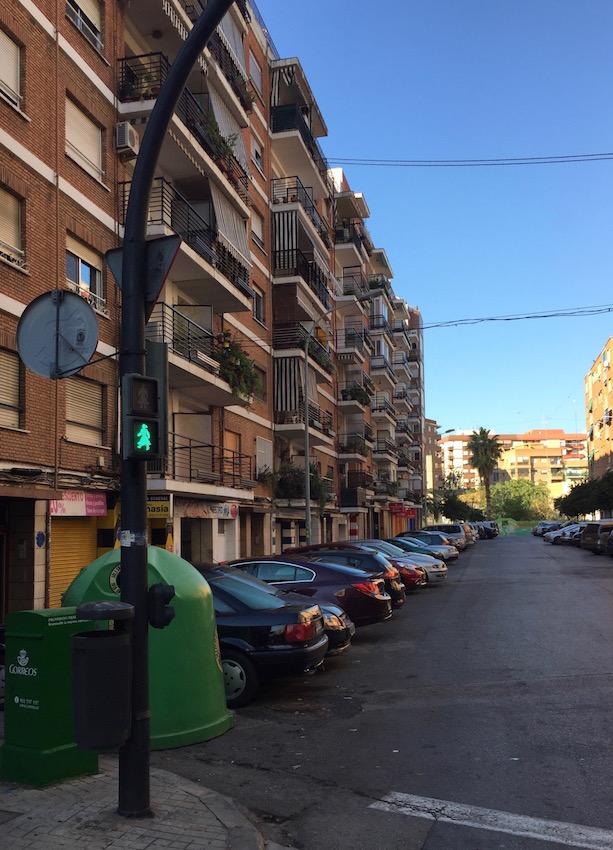
We are privileged to have our Valencian home in an area where real Valencians live. There are no swimming pools. There are no English breakfasts. There are no queuing protocols. There are supermarkets, fishmongers and cafés. There are kids and dogs, and motorbikes, and cars. There are day centres for the elderly. There are people that clean the streets. There are people that make the streets dirty. Things are being built, and things are being refurbished. There is renewal, and there is decay. We would so love to be more involved in the cyclical nature of all this, but as it stands, our time spent in Valencia is short and very precious.

But you get a sense of how hard it can be.

But then you walk through the Jardin del Turia on the way into the old town. When the sun shines in the middle of a December day, you can sit and enjoy the warmth, and enjoy this remarkable park that wraps itself around the heart of the city. It doesn’t make the utility bills disappear, but it might blunt their sharp edges for a little while. I know that the Valencians love and appreciate this place... it’s the first of many things that are quoted as the best things about their city. And it is a beautiful thing.

We shopped and we explored again. We picked up where we had left off in October. The countless orange trees lining the streets were heavily laden. The atmosphere in the city was building towards El Día de los Tres Reyes Magos, and the fever of Las Fallas will inevitably follow. There were new things, redeveloped things, closed things, open things. Café Sant Jaume was well and truly up and running again. For the most part, the weather was sharp and sunny, warm enough for lunch in the sun. We would get back home and doze a little until it was time to enjoy evening Valencia. We enjoyed the different vibes from bars and restaurants only metres apart.

Plaza Doctor Collado. A little heat needed.
In Plaza Doctor Collado one evening, at the foot of the illuminated Christmas tree, a pair of buskers put on a show of flamenco music of such high quality (although I’m no afficionado) that it would have graced any venue. We recognized one of the guys, as we had seen him playing classical Spanish guitar in the past. Now he had been joined by another who played the flute and the guitar, and performed palmas, the essential flamenco clapping that is such an integral part of the performance. I recognised the music of the great Paco de Lucia, and it was fabulous.

By contrast, as we had lunch outside on Paseo Alameda on another day, a busker from the other end of the spectrum treated us to his delights. There are several like him in Valencia. Old men who rock up on their bike, unload their guitar and a small amplifier, and proceed to smash out the tunes. Unfortunately this one, as with many of them, could neither sing nor play. Genuinely awful.

On the way to Paseo Alameda,
lunch, and Pink Floyd's finest.
I normally refuse their requests for money when they are so comically dreadful, but I dropped a little change onto the back of his guitar on this occasion. This sudden flush of philanthropy was based on the fact that I will never, ever hear a version of Pink Floyd’s “Another Brick in the Wall” performed like that ever again. I’m 100% sure that his performance would have persuaded that teacher to leave those kids alone. And run away.

The time to head back to the UK arrived too soon, as ever. We had cleaned up after the painters and left the apartment ready for a couple of potential rentals. One may be for a long period, yet to be confirmed, so our Fallas experience may have to wait another year. Time will tell.

The quality of the queuing at Estacion Joaquín Sorolla was vastly improved. We found our seats on the Alicante train, and watched the other passengers wheel their luggage past the window, searching for the right carriage. A group of Spanish ladies (of a certain age) chattered past, more intent on their conversation that on boarding the right carriage.

A Russian guy with a small dog on his lap was told in no uncertain terms that the animal needed to be in a carrier. He explained (in English) that his wife had the carrier in another carriage. The Spanish RENFE employee was understandably confused, and not just by the language barrier. Luckily an English-speaking colleague arrived to sort it all out, and the Russian guy was marched down the train to marry up small dog with pet carrier. He returned with snarling, yapping dog in pet carrier. Fortunately, it settled eventually, and all was well.

While all of this was happening, 2 of the Spanish ladies (of a certain age) had doubled back towards the door of our carriage. Now, I’ve mentioned this fascinating sub-section of Spanish society before, and the experience hasn’t always been good. I glanced at the 2 empty seats across the aisle from us. You can guess the rest.

The first of these ladies started down the aisle, stopped next to us, and asked a fellow passenger to identify seat 5C for her… “no tengo mis gafas!”. She then realized her companion had got lost somewhere between the carriage entrance and seat 5D, so proceeded to shout to her, then move up the carriage to drag her to their seats.

Lady #1 sighed a rather dramatic “las maletas…” in my general direction, and so it was the guiri to the rescue. I found a place for both her vanity case and her matching suitcase on the luggage racks above them. Inevitably, Lady #2 needed similar help with her identical (El Corte Ingles) luggage. All this luggage-wrangling was eventually complete, and we all settled down.

I was anxious that these ladies might now want to launch into 1hr and 39 minutes of conversation with us. This anxiety was not born from a desire to be antisocial, but my Spanish is nowhere near good enough to converse with these ladies, and I didn’t want them to think I was rude.

I need not have worried. They produced and devoured sandwiches before we had left las afueras de Valencia, followed these up with their medication, and were predictably asleep within 15 minutes.

We enjoyed passing the small towns basking in the December sun, many with castles hovering above them on rocky outcrops. Xativa and Villena. A particularly spectacular castle at Sax. The smooth, efficient train pushed on into Alicante, right on time this time so that we would make our flight home comfortably.

The performance with las maletas was repeated when we arrived in Alicante, of course. Lady #2 got a bit confused, Lady #1 berated her for getting in the way, but they were very grateful and all was well. I was happy that I had been able to help. They got off the train and blocked the platform outside the train door, along with a few others of their species. They don’t care, so neither should we, I reckon.

“If you reject the food, ignore the customs, fear the religion, and avoid the people, you might better stay home.”  
James A. Michener

Alicante airport. A very British queue at the boarding gate, due to it being 100% made up of Brits. The vast majority had been to Benidorm. I’m going to try very hard not to be judgemental here, and relate only the facts, but the following one-sided conversation took place behind us, and could not be unheard:

“I live in Hull, me. On my street, there are 6 foreign shops now. All the English shops are closing, and more foreign shops are opening”.

(Companions mutter casually racist agreement).

“Most of them are Turkish, you know. I don’t know how they get in, do you? Turkey aren’t in the EU are they?”

(Companions mutter casually racist agreement).

30 seconds later:

“I have a lad who’s a joiner, you know. He went on holiday to the States and finished up getting a job there. That was 18 years ago, and he’s still there. We’re right proud of him, we are.”

I’m just going to leave that there.

“Travel brings wisdom only to the wise. It renders the ignorant more ignorant than ever.”
Joe Abercrombie, Last Argument of Kings


Hasta proxima, Valencia. 
Feliz Año Nuevo!!

Friday, 21 December 2018

Malaga - into the melting pot


Malaga's old town... 
bravely clinging onto its charm.
“Walking into the crowd was like sinking into a stew - you became an ingredient, you took on a certain flavour.”  
Margaret Atwood (in The Blind Assassin).

There has been a lot spoken and written about the city of Malaga in recent years. Most commonly, you’ll read the “from seedy to stylish” theme. And I’ve written it myself. You’ll hear how the city has been transformed from a tatty, rarely-visited provincial capital which just happened to have a large airport that provided access to the infamous Costa del Sol resorts. 

Most of it is true. In an unplanned way, we’ve enjoyed a visit to Malaga late in the year for the past 3 or 4 years, and it’s been a delight. I think that what the “seedy to stylish” writers fail to illustrate is that the transformation is continuous, seemingly unstoppable.

La Malagueta - crystal clear in December.
This year’s winter visit (flight times to Valencia were not going to work for us) showed us a Malaga that had moved forward even from 1 year ago. The delightful Muelle Uno now had a little more buzz, a little more style, sleeker boats, more professional restaurants. Going round by the lighthouse, we found that La Malagueta beach had now realized that the city had a lot of visitors in December, and the chiringuitos were operating as if it was July.

There was the usual Christmas market lining one side of the Paseo del Parque, selling buñuelos, candy floss, fireworks and all the usual Spanish street market junk, but principally items for your “Belén”. Belén is the Spanish word for Bethlehem, but more commonly it describes the nativity scenes that are essential part of Navidad in Spain. Many civic buildings have a large, elaborate display, and there will be big queues to view them. Most homes will also have a Belén, and these stalls (along with many shops in town) supply absolutely anything that might conceivably be included in your nativity scene. And some that might not.

Giraffe anyone?

The Alcazaba and the Teatro Romano.
But this year, lining the other side of the Paso del Parque, was a well-presented local food and drink market. Organised by the Sabor a Malaga organization (who appear to be doing amazing things for the gastronomy of the region) this market showcased all the tasty delights that can come to your table from the area.
Malaga old town -
still charming your socks off.
To add to the above, the old town has bravely held on to its past. Below Castillo Gibralfaro, The Alcazaba shimmers above the Teatro Romano and the clean, wide pedestrian walkway that allows you to pass and take it in. New restaurants and bars may sit in the heart of the tourist trap, but they are new and clean and smell of re-development and ambition. And they respect and enhance the old town.

Pleasingly, the old restaurants have not lost any of their edge, any of their consistent push for quality. An old favourite lived up to its reputation on our second night. The organized chaos and genuine welcome that characterizes these places is as unctuous as the great food… you become an ingredient, as Margaret said at the beginning. A jovial old boy on a table near us bought 6 red roses from a circulating seller, and insisted that each of the staff got one.

Even Plaza Merced (as if to scoff at the prediction in my last Malaga post) was still attractive, still a nice place to eat and drink. Starbucks and the Irish bar hadn’t gone away, but they were kept at bay by the care, cleanliness and decent service from their neighbours. The trees and the smoke from the chestnut stalls diffused the beautiful December sunlight, and made it a delightful place to pass a couple of hours.

Plaza Merced shimmers and shines.
People often ask me why I bother with Spain in December.
What characterized this visit most of all, however, was the crowds. Malaga was packed. There were thousands upon thousands of people in the streets at all times of the day and night. 

Thursday 6th December had been Día de la Constitución. Saturday 8th December was Día de la Inmaculada Concepción. These were important days in Spain, particularly with it being the 40th anniversary of the constitution that (most) Spaniards hold so dear. Sunday 9th was the Malaga Marathon. The weather was flawless. But what also attracts these crowds is the fact that Malaga really does Christmas, and most of all, Christmas lights. 

There were some impressive Christmas touches all over town. Lights, trees, smiles, eating, drinking, singing, and fun. Los Malagueños are good at having fun, they have this in common with Los Valencianos. But we must go down to Calle Marqués de Larios to catch the main event. 

Calle Marques de Larios
and the incredible Christmas lights.
This elegant, clean, pedestrianised thoroughfare is where you’ll find the only brands who can afford the rent. From Desigual at the top to Massimo Dutti at the bottom (great shirts) it’s retail paradise if that’s what makes you happy. But from late November through the Christmas season, it is the canvas for the most incredible Christmas light display. 

Soaring above the crowds, and running the whole length of this retail-dedicated avenue, you can see a stunning display. For 2018, the display is based on the stained glass windows and domes of the nearby Cathedral. The city council spend many thousands of Euros on this. 

And it appears to be worth every céntimo in visitor numbers. In the minutes before switch-on at dusk, both Plaza de la Constitución and Marqués de Larios itself are rammed with people, so much so that nobody can move… all the way down to Alameda Principal. The same goes for the twice-nightly musical display where the lights “move” in time with the music. It’s “gilding the lily” in our view, but thousands and thousands take this in, every night. We crossed Alameda Principal one evening from our hotel, and blindly collided with the crowd waiting for this musical spectacular. Stuck. Not moving. Only a little shoving and a little luck got us out of that crowd and into a street where you could actually walk. 

Waiting in their thousands for the switch-on at dusk.
The Spanish love crowds, love crowded places. Moving around the streets (when possible) you become aware of their habit of stopping in groups (obvs) to talk (obvs) in the middle of a crowded street. The tide of humanity has to find a way round, and nobody seems to mind. 

The principal phenomenon, however, is the pace that some of the Spanish can walk at. Typically (but not exclusively) a trait of the slightly older Spaniard, is the ability to look like they’re walking, but they are actually moving at marginally under 0.45 miles per hour (0.724 km/h)*. We have been able to adapt to a slower pace as a result of our experiences of Spain, but to walk at this extraordinarily low pace is not achievable by us, and remains a true wonder. 

We have concluded that this ability to perambulate at less than a snails pace has been very deliberately engineered over many years. It may allow time for eating. It may allow time for smoking. It may allow time for a multitude of activities involving a telefono movil. But mostly it allows time for talking. When you hit the brakes to involve an incident with a slow-moving group on any given Spanish calle or plaza, you know that they will be talking. All of them. At the same time. 

In other words, and with extreme skill, they have taken the simple act of getting from point A to point B, and turned it into a social occasion, an opportunity to pass information and opinion, to instruct, to involve, to arrange, to gossip, to indulge their irresistible urge to talk. 

And this cannot be rushed. 

How we wish we could take our time like this. One day.

Perhaps for a little crowd-avoidance, we went into the cathedral for the first time. My education and previous experience of cathedrals led my mind’s eye to envisage the magnificent gothic structures typified by York Minster, Notre Dame de Paris, Palma de Mallorca Cathedral, and so on. Beautiful, soaring spaces, symmetrical and sometimes austere. 

Truly awesome.
Known as La Manquita (the one-armed Lady) due to an incomplete southern tower, Malaga Catherdral is different. The Renaissance architectural tradition gives the interior layers, perspectives and visual interest that keeps you moving around the inside, as if to make sure you don’t miss what’s on offer to your eyes. Some of the elaborate craftsmanship typical of the catholic tradition is truly incredible. 

Whatever your beliefs, I think a little time spent in places such as this is a must. It takes you away from everything, into a world unaffected by Brexit or broadband speed or beating the traffic or bemoaning the exchange rate. 

We realised with some surprise that we had never even been into Valencia Cathedral, nor seen the (allegedly) very special artefact which is held within. This will be corrected before the end of 2018. Having experienced the magnificence of the Basilica de la Virgen de los Desamparados next door, it’s a keenly anticipated visit. 

So we had taken on a little of the flavor of Malaga. We had become an ingredient for a while. It’s not Valencia. It doesn’t want or need to be Valencia. It has gone from seedy to stylish, but it won’t stop there. We’ll visit again, enjoy the crowds again, and we’ll walk at marginally under 0.45 miles per hour if required. We’ll enjoy what’s new next time, because there will be something new. 

We’ll be back in Valencia over the Christmas holidays. We need to prepare for 2019 rentals, and we need to arrange our own visits for the year. Perhaps Fallas in March, perhaps a long, soporific summer holiday. Perhaps both. 

I’m grateful to Los Malagueños. They’re fun. I think we bumped into all 600,000 of them.


*Not scientifically verified.