Tuesday, 1 January 2019

Estamos todos en un viaje


Valencia isn’t easily accessible from our part of the north of England, at any time of year. Part of me hopes there will always be a few challenges in accessing Valencia from the UK. Even now, with the "easy city break" culture that so many people enjoy, Valencia retains something unexplained, something unique, something secret that I don’t feel in Alicante or the Costa del Sol or the more accessible (and therefore more crowded) Barcelona.

For all its provincial limitations, our local airport in the UK is convenient. But there are no flights to Valencia. When we use this airport, we fly to Alicante and take the train up to Valencia, carefully working out the times of flights and trains, and crossing fingers that there are no delays with either.

The journey is a fascinating part of the trip if you’re prepared to absorb it. Take in all of its many interactions, experience it, and enrich yourself from the whole series of small events.

The flight to Alicante was uneventful. The vast majority of our fellow travelers were headed for Alicante itself, or for Benidorm, of course. Many of the throng had enjoyed a breakfast-time lager in the terminal, but the flight was quiet… we had all been up early.

We grabbed a taxi to Alacant Terminal, and with time to spare, enjoyed a beer or two in the sunshine outside the excellent cafés at the railway station. The snarled traffic outside the station beeped and gesticulated as the weather sparkled.

As the train departure time approached, we passed though security and walked right to the edge of one of the widest cultural chasms that exists between the UK and most of Southern Europe.

Queuing.

The Spanish don’t really see it the way we see it. The protocols around queuing that exist in the UK are similarly observed in Spain, right up to the point where they can’t be arsed to observe them any more, and whole thing breaks down. For Brits (still including ourselves) this takes a bit of getting used to.

The queue snaked back from the booth where they check your tickets, and here, everything was fine. Our delicate queuing sensibilities were satisfied by the gently waving line that had already formed with the magical, shining portal to the Valencia and Barcelona train at its head. These queuers (?) had done well. But latecomers were confused by the need to double back to join the back of the queue, so just joined where they felt appropriate. Soon there were a number of tributaries to the queue river. In the UK, a tributary would never have been allowed. Not ever.

In the UK, the most confident/indignant member of the queue would snarl: “Back of the queue’s there mate” or something along those lines, perhaps accompanied by some eye-rolling and a face slightly flushed with frustration. Here, there was confused muttering, some elaborate hand movements and some tutting… but none of it was directed outwards, it was just another topic of ceaseless conversation within groups.

As if sensing the tension, a RENFE employee announced that there were now 2 ticket booths open, so 2 queues should be formed.

Not the best idea she’s ever had. The queue clearly thought she’d said: “everyone please rush the ticket booths. I repeat, please rush the ticket booths”.

There were a brief few moments of carnage, one or two smaller travelers were crushed under massive wheelie suitcases, but eventually something like 2 ragged, non-UK-style queues naturally formed.

We all had tickets, after all. We weren’t queuing for the last 10 loaves of bread. And nobody actually got crushed, I made that bit up.

We watched the dusty, yellow land north of Alicante slide past as we started towards Valencia. Darkness fell early at this time of year, so we knew that the enchanting sights of fairytale castles perched on seemingly inaccessible crags and mountain-tops would have to wait for the return journey.

We dozed a little, along with the rest of the carriage. The comfortable train continued to slide effortlessly northwards. Before too long, a huge IKEA logo told me that we were passing through Massanssa, just south of Valencia. Buildings soon became recognisable, and we pulled into Estacion Joaquín Sorolla only slightly late. 

Queuing problems at Alicante, apparently.

“We leave something of ourselves behind when we leave a place, we stay there, even though we go away. And there are things in us that we can find again only by going back there.”  
Pascal Mercier, Night Train to Lisbon

There were some changes in the apartment. Our rental agent had made sure to have jobs done in time for our arrival… a little painting, one or two repairs. We reconnected with the place quickly, with the things we had left there, the things that welcomed us back.

Torres Serranos. The last spectacular sight to enjoy
before the old town takes us in.

Out into the mild December evening for the happy little journey into the old town. All the familiar sights along the walk. Where to go, what to drink, what to eat. There is so much to offer, and we are so lucky to be able to enjoy it.

The next day, we took the tranvia to the beach. Marina Real Juan Carlos I and Paseo Maritimo, to bask in sunshine with a beer and to anticipate the Paella Valenciana to come is now customary. The paella didn’t disappoint.

We always relish and appreciate this treat to ourselves, but is this the real Valencia that’s experienced and lived in by “normal” Valencians?

No, it isn’t. It has nothing to do with their everyday struggle with utility bills and IBI tax, nothing to do with what they have to pay when the lift needs servicing in their apartment block, however much they might have wanted to delay this until they have a few more euros to spare.
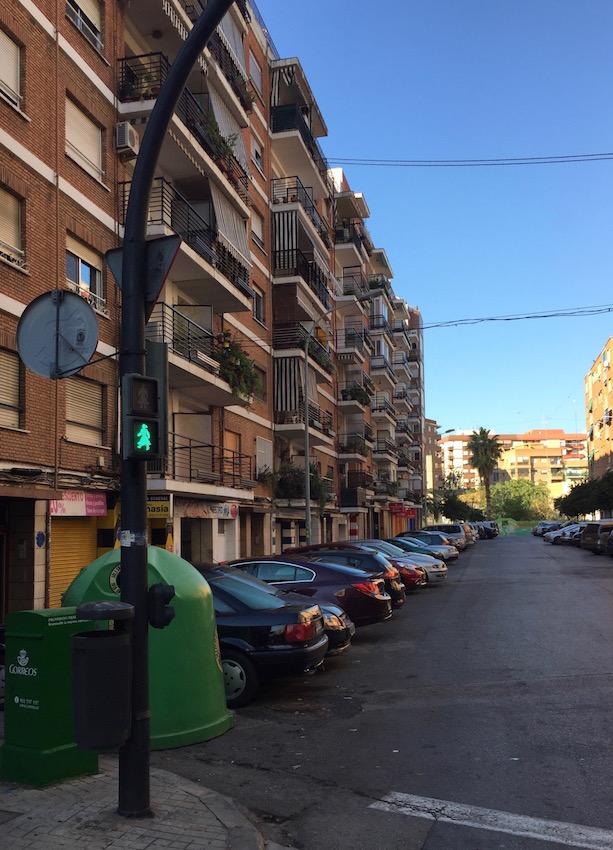
The real Valencia that we are
lucky to be part of.
We are privileged to have our Valencian home in an area where real Valencians live. There are no swimming pools. There are no English breakfasts. There are no queuing protocols. There are supermarkets, fishmongers and cafés. There are kids and dogs, and motorbikes, and cars. There are day centres for the elderly. There are people that clean the streets. There are people that make the streets dirty. Things are being built, and things are being refurbished. There is renewal, and there is decay. We would so love to be more involved in the cyclical nature of all this, but as it stands, our time spent in Valencia is short and very precious.

But you get a sense of how hard it can be.

But then you walk through the Jardin del Turia on the way into the old town. When the sun shines in the middle of a December day, you can sit and enjoy the warmth, and enjoy this remarkable park that wraps itself around the heart of the city. It doesn’t make the utility bills disappear, but it might blunt their sharp edges for a little while. I know that the Valencians love and appreciate this place... it’s the first of many things that are quoted as the best things about their city. And it is a beautiful thing.

We shopped and we explored again. We picked up where we had left off in October. The countless orange trees lining the streets were heavily laden. The atmosphere in the city was building towards El Día de los Tres Reyes Magos, and the fever of Las Fallas will inevitably follow. There were new things, redeveloped things, closed things, open things. Café Sant Jaume was well and truly up and running again. For the most part, the weather was sharp and sunny, warm enough for lunch in the sun. We would get back home and doze a little until it was time to enjoy evening Valencia. We enjoyed the different vibes from bars and restaurants only metres apart.

Plaza Doctor Collado. A little heat needed.
In Plaza Doctor Collado one evening, at the foot of the illuminated Christmas tree, a pair of buskers put on a show of flamenco music of such high quality (although I’m no afficionado) that it would have graced any venue. We recognized one of the guys, as we had seen him playing classical Spanish guitar in the past. Now he had been joined by another who played the flute and the guitar, and performed palmas, the essential flamenco clapping that is such an integral part of the performance. I recognised the music of the great Paco de Lucia, and it was fabulous.

By contrast, as we had lunch outside on Paseo Alameda on another day, a busker from the other end of the spectrum treated us to his delights. There are several like him in Valencia. Old men who rock up on their bike, unload their guitar and a small amplifier, and proceed to smash out the tunes. Unfortunately this one, as with many of them, could neither sing nor play. Genuinely awful.

On the way to Paseo Alameda,
lunch, and Pink Floyd's finest.
I normally refuse their requests for money when they are so comically dreadful, but I dropped a little change onto the back of his guitar on this occasion. This sudden flush of philanthropy was based on the fact that I will never, ever hear a version of Pink Floyd’s “Another Brick in the Wall” performed like that ever again. I’m 100% sure that his performance would have persuaded that teacher to leave those kids alone. And run away.

The time to head back to the UK arrived too soon, as ever. We had cleaned up after the painters and left the apartment ready for a couple of potential rentals. One may be for a long period, yet to be confirmed, so our Fallas experience may have to wait another year. Time will tell.

The quality of the queuing at Estacion Joaquín Sorolla was vastly improved. We found our seats on the Alicante train, and watched the other passengers wheel their luggage past the window, searching for the right carriage. A group of Spanish ladies (of a certain age) chattered past, more intent on their conversation that on boarding the right carriage.

A Russian guy with a small dog on his lap was told in no uncertain terms that the animal needed to be in a carrier. He explained (in English) that his wife had the carrier in another carriage. The Spanish RENFE employee was understandably confused, and not just by the language barrier. Luckily an English-speaking colleague arrived to sort it all out, and the Russian guy was marched down the train to marry up small dog with pet carrier. He returned with snarling, yapping dog in pet carrier. Fortunately, it settled eventually, and all was well.

While all of this was happening, 2 of the Spanish ladies (of a certain age) had doubled back towards the door of our carriage. Now, I’ve mentioned this fascinating sub-section of Spanish society before, and the experience hasn’t always been good. I glanced at the 2 empty seats across the aisle from us. You can guess the rest.

The first of these ladies started down the aisle, stopped next to us, and asked a fellow passenger to identify seat 5C for her… “no tengo mis gafas!”. She then realized her companion had got lost somewhere between the carriage entrance and seat 5D, so proceeded to shout to her, then move up the carriage to drag her to their seats.

Lady #1 sighed a rather dramatic “las maletas…” in my general direction, and so it was the guiri to the rescue. I found a place for both her vanity case and her matching suitcase on the luggage racks above them. Inevitably, Lady #2 needed similar help with her identical (El Corte Ingles) luggage. All this luggage-wrangling was eventually complete, and we all settled down.

I was anxious that these ladies might now want to launch into 1hr and 39 minutes of conversation with us. This anxiety was not born from a desire to be antisocial, but my Spanish is nowhere near good enough to converse with these ladies, and I didn’t want them to think I was rude.

I need not have worried. They produced and devoured sandwiches before we had left las afueras de Valencia, followed these up with their medication, and were predictably asleep within 15 minutes.

We enjoyed passing the small towns basking in the December sun, many with castles hovering above them on rocky outcrops. Xativa and Villena. A particularly spectacular castle at Sax. The smooth, efficient train pushed on into Alicante, right on time this time so that we would make our flight home comfortably.

The performance with las maletas was repeated when we arrived in Alicante, of course. Lady #2 got a bit confused, Lady #1 berated her for getting in the way, but they were very grateful and all was well. I was happy that I had been able to help. They got off the train and blocked the platform outside the train door, along with a few others of their species. They don’t care, so neither should we, I reckon.

“If you reject the food, ignore the customs, fear the religion, and avoid the people, you might better stay home.”  
James A. Michener

Alicante airport. A very British queue at the boarding gate, due to it being 100% made up of Brits. The vast majority had been to Benidorm. I’m going to try very hard not to be judgemental here, and relate only the facts, but the following one-sided conversation took place behind us, and could not be unheard:

“I live in Hull, me. On my street, there are 6 foreign shops now. All the English shops are closing, and more foreign shops are opening”.

(Companions mutter casually racist agreement).

“Most of them are Turkish, you know. I don’t know how they get in, do you? Turkey aren’t in the EU are they?”

(Companions mutter casually racist agreement).

30 seconds later:

“I have a lad who’s a joiner, you know. He went on holiday to the States and finished up getting a job there. That was 18 years ago, and he’s still there. We’re right proud of him, we are.”

I’m just going to leave that there.

“Travel brings wisdom only to the wise. It renders the ignorant more ignorant than ever.”
Joe Abercrombie, Last Argument of Kings


Hasta proxima, Valencia. 
Feliz Año Nuevo!!

Friday, 21 December 2018

Malaga - into the melting pot


Malaga's old town... 
bravely clinging onto its charm.
“Walking into the crowd was like sinking into a stew - you became an ingredient, you took on a certain flavour.”  
Margaret Atwood (in The Blind Assassin).

There has been a lot spoken and written about the city of Malaga in recent years. Most commonly, you’ll read the “from seedy to stylish” theme. And I’ve written it myself. You’ll hear how the city has been transformed from a tatty, rarely-visited provincial capital which just happened to have a large airport that provided access to the infamous Costa del Sol resorts. 

Most of it is true. In an unplanned way, we’ve enjoyed a visit to Malaga late in the year for the past 3 or 4 years, and it’s been a delight. I think that what the “seedy to stylish” writers fail to illustrate is that the transformation is continuous, seemingly unstoppable.

La Malagueta - crystal clear in December.
This year’s winter visit (flight times to Valencia were not going to work for us) showed us a Malaga that had moved forward even from 1 year ago. The delightful Muelle Uno now had a little more buzz, a little more style, sleeker boats, more professional restaurants. Going round by the lighthouse, we found that La Malagueta beach had now realized that the city had a lot of visitors in December, and the chiringuitos were operating as if it was July.

There was the usual Christmas market lining one side of the Paseo del Parque, selling buñuelos, candy floss, fireworks and all the usual Spanish street market junk, but principally items for your “Belén”. Belén is the Spanish word for Bethlehem, but more commonly it describes the nativity scenes that are essential part of Navidad in Spain. Many civic buildings have a large, elaborate display, and there will be big queues to view them. Most homes will also have a Belén, and these stalls (along with many shops in town) supply absolutely anything that might conceivably be included in your nativity scene. And some that might not.

Giraffe anyone?

The Alcazaba and the Teatro Romano.
But this year, lining the other side of the Paso del Parque, was a well-presented local food and drink market. Organised by the Sabor a Malaga organization (who appear to be doing amazing things for the gastronomy of the region) this market showcased all the tasty delights that can come to your table from the area.
Malaga old town -
still charming your socks off.
To add to the above, the old town has bravely held on to its past. Below Castillo Gibralfaro, The Alcazaba shimmers above the Teatro Romano and the clean, wide pedestrian walkway that allows you to pass and take it in. New restaurants and bars may sit in the heart of the tourist trap, but they are new and clean and smell of re-development and ambition. And they respect and enhance the old town.

Pleasingly, the old restaurants have not lost any of their edge, any of their consistent push for quality. An old favourite lived up to its reputation on our second night. The organized chaos and genuine welcome that characterizes these places is as unctuous as the great food… you become an ingredient, as Margaret said at the beginning. A jovial old boy on a table near us bought 6 red roses from a circulating seller, and insisted that each of the staff got one.

Even Plaza Merced (as if to scoff at the prediction in my last Malaga post) was still attractive, still a nice place to eat and drink. Starbucks and the Irish bar hadn’t gone away, but they were kept at bay by the care, cleanliness and decent service from their neighbours. The trees and the smoke from the chestnut stalls diffused the beautiful December sunlight, and made it a delightful place to pass a couple of hours.

Plaza Merced shimmers and shines.
People often ask me why I bother with Spain in December.
What characterized this visit most of all, however, was the crowds. Malaga was packed. There were thousands upon thousands of people in the streets at all times of the day and night. 

Thursday 6th December had been Día de la Constitución. Saturday 8th December was Día de la Inmaculada Concepción. These were important days in Spain, particularly with it being the 40th anniversary of the constitution that (most) Spaniards hold so dear. Sunday 9th was the Malaga Marathon. The weather was flawless. But what also attracts these crowds is the fact that Malaga really does Christmas, and most of all, Christmas lights. 

There were some impressive Christmas touches all over town. Lights, trees, smiles, eating, drinking, singing, and fun. Los Malagueños are good at having fun, they have this in common with Los Valencianos. But we must go down to Calle Marqués de Larios to catch the main event. 

Calle Marques de Larios
and the incredible Christmas lights.
This elegant, clean, pedestrianised thoroughfare is where you’ll find the only brands who can afford the rent. From Desigual at the top to Massimo Dutti at the bottom (great shirts) it’s retail paradise if that’s what makes you happy. But from late November through the Christmas season, it is the canvas for the most incredible Christmas light display. 

Soaring above the crowds, and running the whole length of this retail-dedicated avenue, you can see a stunning display. For 2018, the display is based on the stained glass windows and domes of the nearby Cathedral. The city council spend many thousands of Euros on this. 

And it appears to be worth every céntimo in visitor numbers. In the minutes before switch-on at dusk, both Plaza de la Constitución and Marqués de Larios itself are rammed with people, so much so that nobody can move… all the way down to Alameda Principal. The same goes for the twice-nightly musical display where the lights “move” in time with the music. It’s “gilding the lily” in our view, but thousands and thousands take this in, every night. We crossed Alameda Principal one evening from our hotel, and blindly collided with the crowd waiting for this musical spectacular. Stuck. Not moving. Only a little shoving and a little luck got us out of that crowd and into a street where you could actually walk. 

Waiting in their thousands for the switch-on at dusk.
The Spanish love crowds, love crowded places. Moving around the streets (when possible) you become aware of their habit of stopping in groups (obvs) to talk (obvs) in the middle of a crowded street. The tide of humanity has to find a way round, and nobody seems to mind. 

The principal phenomenon, however, is the pace that some of the Spanish can walk at. Typically (but not exclusively) a trait of the slightly older Spaniard, is the ability to look like they’re walking, but they are actually moving at marginally under 0.45 miles per hour (0.724 km/h)*. We have been able to adapt to a slower pace as a result of our experiences of Spain, but to walk at this extraordinarily low pace is not achievable by us, and remains a true wonder. 

We have concluded that this ability to perambulate at less than a snails pace has been very deliberately engineered over many years. It may allow time for eating. It may allow time for smoking. It may allow time for a multitude of activities involving a telefono movil. But mostly it allows time for talking. When you hit the brakes to involve an incident with a slow-moving group on any given Spanish calle or plaza, you know that they will be talking. All of them. At the same time. 

In other words, and with extreme skill, they have taken the simple act of getting from point A to point B, and turned it into a social occasion, an opportunity to pass information and opinion, to instruct, to involve, to arrange, to gossip, to indulge their irresistible urge to talk. 

And this cannot be rushed. 

How we wish we could take our time like this. One day.

Perhaps for a little crowd-avoidance, we went into the cathedral for the first time. My education and previous experience of cathedrals led my mind’s eye to envisage the magnificent gothic structures typified by York Minster, Notre Dame de Paris, Palma de Mallorca Cathedral, and so on. Beautiful, soaring spaces, symmetrical and sometimes austere. 

Truly awesome.
Known as La Manquita (the one-armed Lady) due to an incomplete southern tower, Malaga Catherdral is different. The Renaissance architectural tradition gives the interior layers, perspectives and visual interest that keeps you moving around the inside, as if to make sure you don’t miss what’s on offer to your eyes. Some of the elaborate craftsmanship typical of the catholic tradition is truly incredible. 

Whatever your beliefs, I think a little time spent in places such as this is a must. It takes you away from everything, into a world unaffected by Brexit or broadband speed or beating the traffic or bemoaning the exchange rate. 

We realised with some surprise that we had never even been into Valencia Cathedral, nor seen the (allegedly) very special artefact which is held within. This will be corrected before the end of 2018. Having experienced the magnificence of the Basilica de la Virgen de los Desamparados next door, it’s a keenly anticipated visit. 

So we had taken on a little of the flavor of Malaga. We had become an ingredient for a while. It’s not Valencia. It doesn’t want or need to be Valencia. It has gone from seedy to stylish, but it won’t stop there. We’ll visit again, enjoy the crowds again, and we’ll walk at marginally under 0.45 miles per hour if required. We’ll enjoy what’s new next time, because there will be something new. 

We’ll be back in Valencia over the Christmas holidays. We need to prepare for 2019 rentals, and we need to arrange our own visits for the year. Perhaps Fallas in March, perhaps a long, soporific summer holiday. Perhaps both. 

I’m grateful to Los Malagueños. They’re fun. I think we bumped into all 600,000 of them.


*Not scientifically verified.


Thursday, 18 October 2018

El Orgullo

Pride: The state or feeling of being proud.

Pride: A becoming or dignified sense of what is due to oneself or one's position or character; self-respect; self-esteem.

Pride: Pleasure or satisfaction taken in something done by or belonging to oneself or believed to reflect credit upon oneself: civic pride, national pride.

Pride: Something that causes a person or persons to be proud: His art collection was the pride of the family.

Pride: To indulge or plume (oneself) in a feeling of pride (usually followed by on or upon): They pride themselves on their beliefs.

Pride (idiom): pride and joy, someone or something cherished, valued, or enjoyed above all others: Their daughter is their pride and joy.

Pride (movement): Is the positive stance against discrimination and violence toward lesbian, gay, bisexual and transgender (LGBT) people to promote their self-affirmation, dignity, equality rights, increase their visibility as a social group, build community, and celebrate sexual diversity and gender variance.

For the purposes of this blog post, I have selected the most appropriate definitions of pride from the countless definitions that exist. If your particular favourite (e.g. Lions) is not in my little list, I apologise. 
The Valencian flag hangs above the
Torres Serranos - one of the gateways to the old city.

October 9th is the national day of the autonomous region of Valencia, Communidad Valenciana. The celebration as a whole is known as “Nou d’Octubre”, and is celebrated with events over several days leading up to its climax on the 9th.

It is a major event for Valencians across the entire region, and we wanted to experience it.

Arriving late on the 6th, it was drop bags and find food. In a very busy old town, we were lucky to find a table in a tapas place. The place was packed and typically deafening. We now fall easily into the way Valencia works. Service is slow, but who cares? Some dishes have sold out, so we’ll choose something else. The waiter seems rude, but engage him a little, and you’ll realize that he’s busy, not rude.

Marina Real Juan Carlos I.
The 7th is a Sunday, and we like to spend these Sundays around the Marina Real Juan Carlos I where there are sunny, comfortable bars overlooking the marina. We’ll wander down to Paseo Maritimo for lunch. Here, you choose your eating venue with care. There are informal café bars and formal restaurants, but many visitors have been fooled by a linen tablecloth. Having booked what we think is the best, we enjoyed the usual quality experience. Good service, great food.

At this iconic old restaurant, their pride in their work is obvious. As is often the case, there is a young man experiencing his first busy Sunday as a camarero. Nervous as a kitten, he’s only permitted to clear tables. His only mission is to not drop any crockery. Mission not accomplished. We’ll see him again next year as a confident, professional, waiter taking pride in doing a good job, highly valued by colleagues and customers.

Salon Dorado in the Palau de la Generalitat.
There is also the aged Jefe. He must be in his 80s, and he clearly cannot tear himself away from making sure the huge dining room runs as he believes it should. Every time we visit, we silently implore him to swallow his pride, and go home and get his feet up, or at least sit down with his family and enjoy lunch!

Monday 8th is where Nou d’Octubre really starts for us. We start to immerse ourselves in this celebration of Valencian culture.

To mark the celebrations, many of the civic and parliamentary buildings are open to the public. The Palau de la Generalitat is a magnificent 15th century palace, now the headquarters of the Valencia government. It towers over the Plaza de la Virgen so it’s never far from view, but you don’t get to see inside it every day. It’s a privilege to stand in the immense entrance hall and see the golden ceiling and the incredible tiled floor of the Salon Dorado.

The Real Senyera de Valencia in the Salon de Crystal.
We visited the Ayuntamiento (city hall), which is an eclectic mix of 18th and 20th century construction overlooking Plaza Ayuntamiento, the civic heart of Valencia. From its balcony, the mayor and other dignitaries preside over events and celebrations. It’s where the Falleras gather to view the Mascletas during Las Fallas… the best seat in the house. For Nou d’Octubre, the breathtaking Salon de Crystal displays the Real Senyera de Valencia. This flag (here we go with flags again) is symbolic of Valencia itself for many, and is carried at the head of the main parade on the 9th. It was fascinating to see other rooms in the Ayuntamiento also, displaying maps and artifacts from a proud and dramatic history.

Plaza Ayuntamiento is a fitting centerpiece to the city. Entering from the Estacion del Norte at the southern end, you pass the Hard Rock Café and the Valencia Club de Futbol shop. The main Post Office is an incredible building that faces off against the Ayuntamiento across the square. Countless buses and taxis mix in a coordinated chaos of traffic lights and noise as you pass the imposing Ateneo Mercantil building and approach the northern end towards Mercado Central. Chain shops and restaurants crowd the apex of the triangular square, but a glance upwards and around you confirms that here is where the “soaring architecture” of Valencia has its home. Hotels, banks and apartment buildings rise like the sides of a steep ravine above the mass of commercial clamor, as if to hold it firmly in its place.

Plaza Ayuntamiento - the pointy end.
We knew that the next day, a large part of the square would be dedicated to a keenly anticipated Mascleta, the traditional daytime firework display.

That evening was wet. We enjoyed a fantastic meal just around the corner from the Correos building, and made sure we were in time for the highlight of the day, and the event that heralded the arrival of Nou d’Octubre itself.

We know that the Valencians love fireworks, you hear them randomly around the city all the time. We know about Las Fallas, and we know that pyrotechnics are a major player throughout. But nothing can really prepare you for unbridled Valencian fireworks when you have a front row position.

The skies had cleared out of respect for what was to come. At 11.50 pm a single explosion above us gave a 10-minute warning. Another at 11.55. Then we enjoyed the first colours and noise of the display from our position close to the riverbed park between two bridges, Puente del Exposicion and Puente de las Flores. We watched alongside thousands of Valencians and visitors standing in the closed roads that run alongside the riverbed park. We see excellent firework displays on November 5th and on New Year’s Eve in the UK, and across the world on TV.

Nothing compared to seeing this up close.

There was an overwhelming sense that this had been designed and executed with great skill. The very knowledgeable Valencian crowd showed their appreciation as the display built in colour, noise and intensity. As inexperienced firework spectators, we sensed the climax of the display was close, but it continued to reach new peaks. Again and again we assumed a big finish was imminent, only to see it surpassed. When the display did finally reach its big finish, it was awesome enough to be emotional.

I get it now. I get why they love this so much. I’ve never really been that impressed by fireworks, but this was incredible. I got the impression from the Valencians around us that this display had been marked at around 8 out of 10 by their exacting standards. For us, it was an amazing experience.

Midnight had passed, it was Nou d’Octubre. A drink for luck at Café de las Horas, and home.

The weather was moody on the morning of the 9th. It was humid, cloudy, and very warm. On our walk into town from La Saidia, we walked through the Medieval Market specially set up on Puente Serranos and all the way up to and through Torres Serranos into Plaza dels Furs. At times, it was almost impossible to get through the crowds on the bridge, so you had no choice but to be assaulted by the sounds and smells of this market. Mostly smells. The cheese stalls had a distinctive odour before the big day, but by the following Friday we were using another bridge.

In 2017, there had been violence around the main Nou d’Octubre parade. Political groups know the eyes of Spain will be on the city today, and they will use this day to make their voices heard. We were unable to walk through Plaza de la Virgen that morning, as the policia had isolated one protesting group in there, waiting for the appropriate time to release them to exercise their right to demonstrate.

La Senyera proudly worn.
Flags. As we got closer to Plaza Ayuntamiento, flags were what you could see. Mostly the Valencian flag, but mixed with the Spanish flag "La Rojigualda” and those of various political movements. No Bob Esponja balloons here… this wasn’t a joyful Easter Sunday in the Cabañal, the atmosphere was very different.

A tide of humanity had moved into Plaza Ayuntamiento. Unsure of the best vantage point, and acutely aware of the violent exchanges of 2017, we moved through the crowds towards the Ayuntamiento.

Choosing a position where we could see the balcony of the Ayuntamiento, but also most of the square as well, I kept an eye on the throng. All Valencian life was here, plus many visitors. Most had flags. The Valencian Senyera was carried in its thousands of course, but many others also. The group had been released forom the Plaza de la Virgen, and carried blue flags, but I wasn’t sure of their allegiances. There were many versions of the Spanish flag with various black symbols added, signifying beliefs and movements. There was the LGBT Rainbow flag and the flag of the Republic. The police had permitted some small marches, and one passed by us… a young moderate right-wing group it seemed, peacefully demonstrating alongside those who championed Valencia as part of a unified Spain, untainted by the extremism of the Catalan struggle for independence.

Nou d'Octubre in Plaza Ayuntamiento.
There was a sense of excitement and anticipation, perhaps even tension, but trouble did not flare. The neo-nazi ultraderechas who had been at the centre of the violence in 2017 appeared to be absent. There was chanting and posturing from many parts of the square, but everyone appeared to be coexisting in relative harmony.

Later, we learnt that most of the ultraderechas had been held by the riot police in a square close to Plaza Ayuntamiento for the duration of the day. Only a few stragglers had tried (and failed) to cause trouble on the edge of the square, which barely anyone noticed. I got the impression that the police and security forces had handled a very difficult situation extremely well. There was certainly no leave granted that day, they were a big, visible, proactive presence.

The parade makes its way along
Calle San Vicente Martir.
Several loud firework explosions heralded the start of the main parade. The Real Senyera de Valencia was slowly marched onto the balcony and lowered to the Valencian politician who had been granted the privilege of leading the parade, and so it set off at a stately pace towards Calle San Vicente Martir.

We used the alleys around the square to move to a place on the very same street. The atmosphere was intense by now, and you felt much more up close and personal with this parade than you might feel at Easter in the Cabañal. San Vicente is quite an enclosed street as you get towards Plaza de la Reina. It was packed, and many people had an opinion that needed to be loudly directed at some of the parading dignitaries. Very suddenly, a large group of forest firefighters appeared across the street from us, chanting loudly in a protest about their rights and conditions, closely followed by police in riot gear who allowed their protest but hemmed it in.

Beautiful traditional Valencian dress.
The parade filed past, led by the traditional uniformed riders. Politicians and their parties, the leaders of the military and security forces 6 or 7 abreast, the Falleras and their entourage and the many cultural organisations were all represented, and most were applauded with real pride and appreciation. Our firefighter friends of course, saved their very loudest jeers for the Government leaders, and for the Mayor and his team. Husbands made their views loudly known, and wives tried to silence them. Old ladies rudely pushed to the front and cared not how they brandished their flags.

Along with many others, we broke away once the main parade was past, and made our way down the Plaza Alfonso el Magnanimo. This is where the head of the parade lays a floral tribute at the base of the magnificent statue of King Jaume 1. This King of Aragon liberated Valencia from the Moors. It couldn’t have happened without him. A few flowers are the least he can expect.

We couldn’t see any of this… too many proud Valencians!

So in our thousands, we made our way back to Plaza Ayuntamiento. As soon as the parade returned there, and the great and the good filled the balcony once more, it would be time for the Mascleta. This was a watershed moment in our Valencian experiences. We had heard so many things about the Mascleta. Pregnant women shouldn’t attend, hearing can be damaged, etc, etc, but we had decided that we needed to experience this.

We found a place in front of the Correos, facing the middle of the square, only 3 back from the barrier. For Mascleta first-timers, this just might be too close. The anticipation was palpable. These people absolutely love this stuff.

No photograph will ever do justice to a Mascleta.
The sun came out, and it was hot. Cans of beer were sold from dustbins full of ice. People peered from the parapets of the huge buildings, countless floors up. Someone fainted at the front, and was rescued by an ambulance crew. People of all ages waited until that balcony was full again, and the Mascleta could start. The emergency services took their positions.

Eventually, a series of single airborne explosions heralded the start of the display. Every pigeon fled simultaneously from every building in the square. The police helicopter stayed at a respectful distance. The explosions and smoke built and built until the sound physically pushed at you. To rapturous cheers, a series of fireworks exploded upward with smoke that painted the colours of the Valencian flag into the blue sky. The display approached its climax with an intensity of noise that moved the air around you. I think the crowd gave this one a 9.

This was amazing. I really do get it now. You can consider us converted. So much so that over lunch, we readily agreed that we would go to Las Fallas 2019, for (much) more of the same!!

Here come the Christians.
Later that day, the traditional Moors and Christians parade celebrated the expulsion of the Moors from the city. A heavy shower turned to steady drizzle, but the enthusiasm and colour of the parade remained. As with the Easter parades, it leaves one wondering how all of this is prepared and executed. The thousands of costumes. The training of people, horses and even camels. It is an amazing undertaking.

As the last group of Holy Knights and their accompanying musical entourage passed by, Nou d’Octubre was over for 2018.

Amazing details at La Lonja.
We spent the remaining days of this visit just being part of a slightly quieter Valencia. Coffee and empanadas standing at the counter in Mercado Central. Buy some saffron, some bargain pictures for the single room, a cushion cover, and a bigger sugar pot. Get lost in La Xerea and discover the amazing San Juan del Hospital purely by chance. Marvel at La Lonja once again. Stare up at a building for sale just off Plaza Ayuntamiento, and discuss unrealistic plans to buy and refurbish it. Make running repairs to the apartment. Explore the fascinating “Bazar Chino” shops that appear on every street. Pick up a bit more Spanish. Take our time at Café Sant Jaume, the world’s premier people-watching venue.

A peaceful part of the old city.
Once or twice, I caught myself feeling something new. Then I realized it was the feeling of being completely at home. It took me by surprise… but it was oddly comforting at the same time. And of course it made me feel proud. The apartment was no longer a project or a novelty. It was now much more than a comfortable base from which to explore the city and area like a tourist. It had become a home that we were lucky enough to have. A home that means we can live in Valencia, only not on a full-time basis.

In conversation, I heard myself telling people that we had a home in Valencia (to make sure they knew I wasn’t a tourist!), where I had never described it as a home before. There had been a shift in how we perceived the apartment and the city, and what it meant to us. I think maybe I was a bit proud.

On our last day, we went to Meat Carnival 2018. Billed as “the greatest meat and live coal festival in Spain”. It was all set up in part of the Marina. We ran the gauntlet of Vegans holding up signs about murder (but who were oddly inactive in any other way, so it wasn’t much of a gauntlet), and walked into a large collection of outdoor stalls cooking up barbecued meat dishes in various forms, plus 2 huge outdoor bars (qué sorpresa) and numerous other drinks outlets. Carnivore heaven.

We took it all in, and surveyed the meaty options over a beer. There were 4 whole lambs spread over coals in one corner. There was a cooking demo where the enthusiastic host talked us through how the lady next to him was making a chicken sandwich. Cutting this sandwich at attractive angles appeared to be the highlight of the whole operation. The next demo involved whisky tasting, and attracted a larger crowd for some reason.

We opted for Argentinian choripan and steak. People were walking around with oysters on ice for tasting. The sun blazed down, and most Valencians found shade at the bar. There was a Fallas-style ninot of a 3-foot steak over a grill surrounded by bags of charcoal. A guitarist belted out the tunes close to a double-decker bus selling chicken wings. A whole row of other stalls grilled up beef, meatballs, various sausage varieties, and pulled pork (obvs).

We had another beer and tried to imagine what all of this might be like by 10pm. I think they’d have got through an insane amount of Amstel Oro and wagyu burgers by then. The diet of champions.

The upstairs chamber at La Lonja.
Those Valencians and their tiles.
We packed a lot into this visit. So many new experiences. A Nou d’Octubre parade. The inside of the Palau del la Generalitat and the Ayuntamiento. A Valencian firework display. A Mascleta. Seeing a camel walking up Calle la Paz. A Meat Carnival. A forest firefighters demo. New enchanting parts of the Barrio del Carmen. The sights and smells (but mostly smells) of a “Medieval” market, that wasn’t very Medieval.

And the feeling of being completely at home.

Perhaps a visit at Christmas, and then what will be an amazing Las Fallas 2019. This will all happen well before the dreaded Brexit date of 29th March, so we will be able experience the flames and the fireworks and the joy.

It remains to be seen how the shambles of Brexit will affect our visits to Valencia, and the degree of permanence we can enjoy as time passes.

We’ll see. At the moment, I don’t know if I’m going or leaving home.